September 11, 2026 · News
Navier-Stokes 2026: Niva publicly releases NSBU, highlighting architectural divergence in physical AI
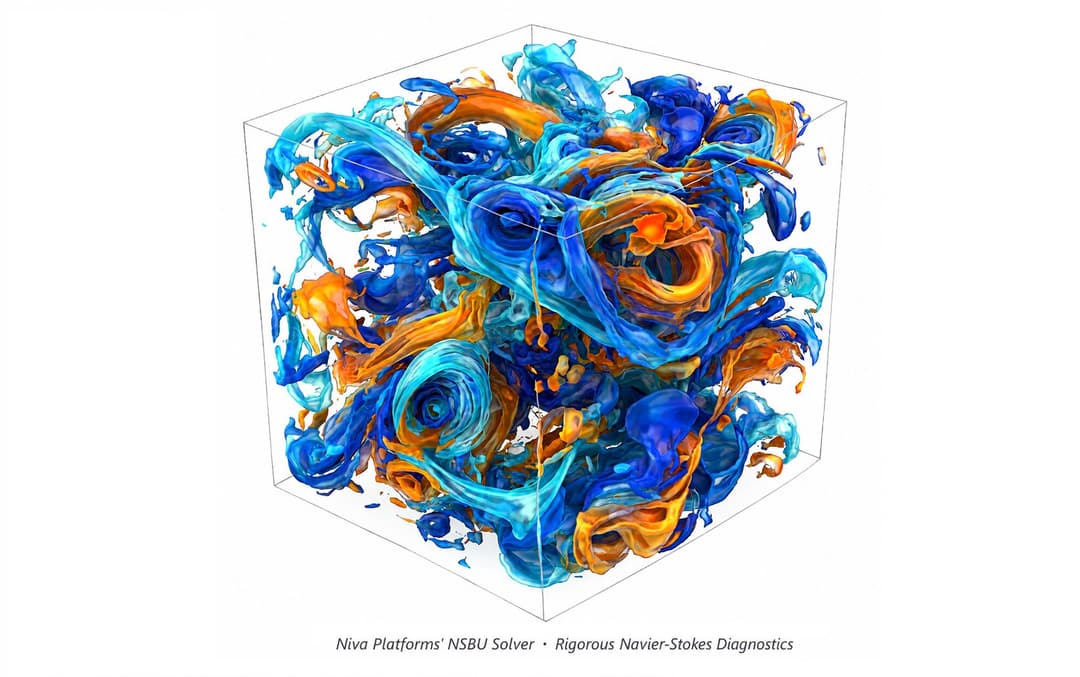
Caption: Representation of Navier-Stokes three-dimensional turbulent fluid flow inside a bounded volume.
The Navier-Stokes moment
On 8 September 2026, two teams posted AI-assisted proof announcements on the Navier-Stokes equations, one of the seven Clay Millennium Prize problems. NYU mathematician Tristan Buckmaster and Anthropic researcher Levent Alpöge published three Lean-verified blow-up proofs for related fluid equations, produced through a year of collaboration using Anthropic’s Claude and OpenAI’s Codex. OpenAI announced a roughly 166-page proof of finite-time blow-up for the forced Navier-Stokes equations, produced by 10,000 coordinated internal agents running for 88 hours on approximately $22 million of compute and 130 billion tokens. The two announcements arrived one day apart, and a public dispute over credit followed almost immediately. The mathematical community is still working through both results. The Clay Institute has not certified anything, and the prize remains officially unclaimed.
Coverage in popular press has described AI as having ‘solved’ the Navier-Stokes problem. That framing does not match what actually happened, and the gap is worth addressing.
Niva’s contribution
On 11 September 2026, Niva Platforms publicly released NSBU (Navier-Stokes Blow-Up Solver), an open-source Rust implementation of a deterministic runtime for incompressible three-dimensional Navier-Stokes simulation, on GitHub. The release is diagnostic-only alpha. It does not resolve the Clay problem, does not audit any existing proof, and reaches zero accepted PDE convergence windows in this alpha. It contributes classical numerical infrastructure at the verification layer where the community actually needs it.
The architectural discipline is the same which grounds Niva’s Manifold platform: physics-native computation on governing equations, deterministic outputs, independent Python and Rust reference implementations at higher arithmetic precision than the runtime, transactional commits, and explicit separation between what the runtime does and what has been scientifically qualified. Every diagnostic report is labeled UnqualifiedDiagnostic and enumerates the qualification channels that remain open. The community can run, inspect, and extend the code without millions of dollars in compute or hundreds of billions of tokens.
GitHub link: Niva’s NSBU Solver, released under Apache 2.0 license. https://github.com/nivatechnologies/nsbu-solver.
What is Navier-Stokes?
The Navier-Stokes equations describe how viscous fluids move under pressure, viscosity, and external forces. They underpin weather forecasting, aircraft design, ocean modeling, and blood flow simulations. Written down in the nineteenth century, they work extraordinarily well in practice, but a fundamental mathematical question about them has been open for roughly 90 years: given a smooth three-dimensional fluid moving at finite energy, does the mathematical solution always remain smooth, or can it develop a singularity in finite time where speed grows unbounded?
That question is one of the seven Clay Millennium Prize problems, each carrying a $1 million award. While the award may be the outward focus, the real prize is computationally understanding turbulence, one of the last great unsolved problems of classical physics.
The Clay problem and what ‘forced’ means
The Clay problem statement has four formulations: Two of them (A and B) focus on unforced equations, where the fluid moves on its own. The other two (C and D) permit an external force, a continuing push applied to the fluid, provided the force is smooth and the total energy remains finite.
OpenAI’s announced proof targets statements C and D. The Buckmaster-Alpöge results also work in the forced setting, focused on the related Euler and Boussinesq equations. Most working mathematicians consider the unforced formulations the deeper question, as the forced version can be viewed as engineering a ‘blow-up’, by choosing the applied force. The forced results are real mathematical contributions, and they are part of the Clay statement, but they do not resolve the version of the problem the community typically cares about most. Whether either approach extends to the unforced case is not yet clear.
Two approaches, results released same day
Setting aside the credit fight, which is a real dispute, the more important comparison is between approaches.
Buckmaster and Alpöge worked for a year with Claude and Codex, extending an approach developed by Diego Córdoba and Luis Martínez-Zoroa. The AI models identified key elements of prior work, helped reproduce arguments, and handled bookkeeping of inductive constants under the mathematicians’ direction. In essence, this is human-led research with AI tools accelerating specific tasks.
OpenAI's approach was different in kind. Roughly 10,000 concurrent agents running an internal model more capable than GPT-6 Astra searched proof space for 88 hours, consuming 130 billion output tokens and $22 million of compute, with humans redirecting agents and consolidating insights. AI model as driver, human collaborators as refiners. That token figure is on the order of the annual AI consumption of a large enterprise, directed at one mathematical problem over 88 hours. The output was a 166-page proof and a Lean formalization. This is the quintessential compression-and-scale approach in practice: massive learned models, agentic search over proof spaces, verification of the output after the fact.
Both approaches produced Lean-verified results. Both targeted the forced version of the problem. Both are serious mathematical contributions. They represent two different visions of what AI-assisted mathematics looks like, and the visions matter beyond this problem.
Clarifying the situation
Popular press coverage has treated the recent announcements as if AI has closed a 90-year-old mathematical question - that is not what happened. The Clay Mathematics Institute continues to list the Navier-Stokes existence and smoothness problem as unsolved. Both proof efforts target a specific version of the problem that most working mathematicians consider narrower than the version they care about most. Peer review has not completed. Independent verification, replication, and community understanding of what the proofs actually establish are all still ahead.
The gap between ‘AI solved it’ and what actually happened is the story, as well as what the approaches portend. Fields Medalist Terence Tao warned about this exact dynamic in his July 2026 address at the International Congress of Mathematicians. AI has driven the cost of proof generation near zero. The community’s ability to verify, digest, canonicalize, and understand those proofs has not scaled with it. This problem is what Niva refers to as ‘grounded adjudication’, which is examined in detail in an upcoming paper. The scarce resource is no longer proofs - it is verification and understanding.
Two paradigms: Compression-and-scale, and native determinism
Compression-and-scale is what powers transformer-based AI and agentic search. The operational computation is a forward pass through learned parameters trained on a corpus, and verification, where it happens, occurs after the fact through filters or formal checks. Native determinism is a different architectural commitment: the operational computation is a deterministic computation on governing equations, with determinism, guaranteed validity, and auditability enforced by construction rather than checked afterward. Where learned components exist inside a native deterministic architecture, they are architecturally bounded to roles that cannot impair the operational path.
The two paradigms make different kinds of contributions to a problem like Navier-Stokes. Compression-and-scale can search proof space at massive parallelism and produce candidate proofs of specific formulations, in specific forced regimes, at substantial compute cost. Native determinism does not generate proofs. It provides the coupled-physics runtime computation, on governing equations, that the community needs to examine trajectories, coupled behavior, and eventually the numerical evidence around any specific claim. One paradigm generates candidates. The other provides the qualified computational substrate against which candidates can be examined. Both are necessary. Neither, on its own, resolves a problem this hard.
Niva’s NSBU demonstrates what the native deterministic paradigm looks like in practice. Coupled physics is computed on the governing Navier-Stokes equations directly, using Fourier pseudospectral discretization, at low compute cost, on hardware anyone can afford. Independent reference implementations in Python and Rust, with arithmetic checks at 80 and 120 decimal digits, are inside the release itself. Every diagnostic report identifies UnqualifiedDiagnostic and enumerates the qualification channels that remain open.
That last point is the architectural signature: the runtime model is incapable of overstating what it has established. Compression-and-scale produces outputs whose qualification depends on external verification that may or may not follow. Native determinism produces qualified computation, and when qualification is incomplete, the architecture states it as such.
That structural refusal to overstate is what the architecture guarantees, and aligns with the grounded approach Tao named earlier this year. Niva’s NSBU shows what it looks like when applied to this problem space - and the community can now examine, extend, and build on it directly.
The shape of things to come
The recent events surrounding Navier-Stokes, and the headline coverage that followed them, are good illustrations of what physical AI is becoming and where limitations with conventional approaches remain.
Compression-and-scale is generating candidates faster than the community can verify them. When those candidates arrive in domains where verification matters most, like the sciences that govern flight, weather, materials, and infrastructure, the gap between ‘AI produced an output’ and ‘what that output means and how valid is it’ widens. This is the same architectural gap Niva has been naming across space, manufacturing, and robotics for physical AI at runtime. Manifold applied to spacecraft, factories, and robots, and NSBU applied to Navier-Stokes, are the same architectural commitment applied to various problem sets that all share a common foundation - constitutive physics.
Niva builds native deterministic infrastructure, and where appropriate, shares tools and insights publicly because the verification layer of physical and mathematical AI must belong to the community, not to whichever lab has the largest compute budget.
NSBU research article
The NSBU technical brief is available on the Research page: https://www.nivatech.io/research/research-nsbu-open-source-deterministic-runtime-for-rigorous-navier-stokes-diagnostics