September 11, 2026 · Development
Research: NSBU - Open-Source Deterministic Runtime for Rigorous Navier-Stokes Diagnostics
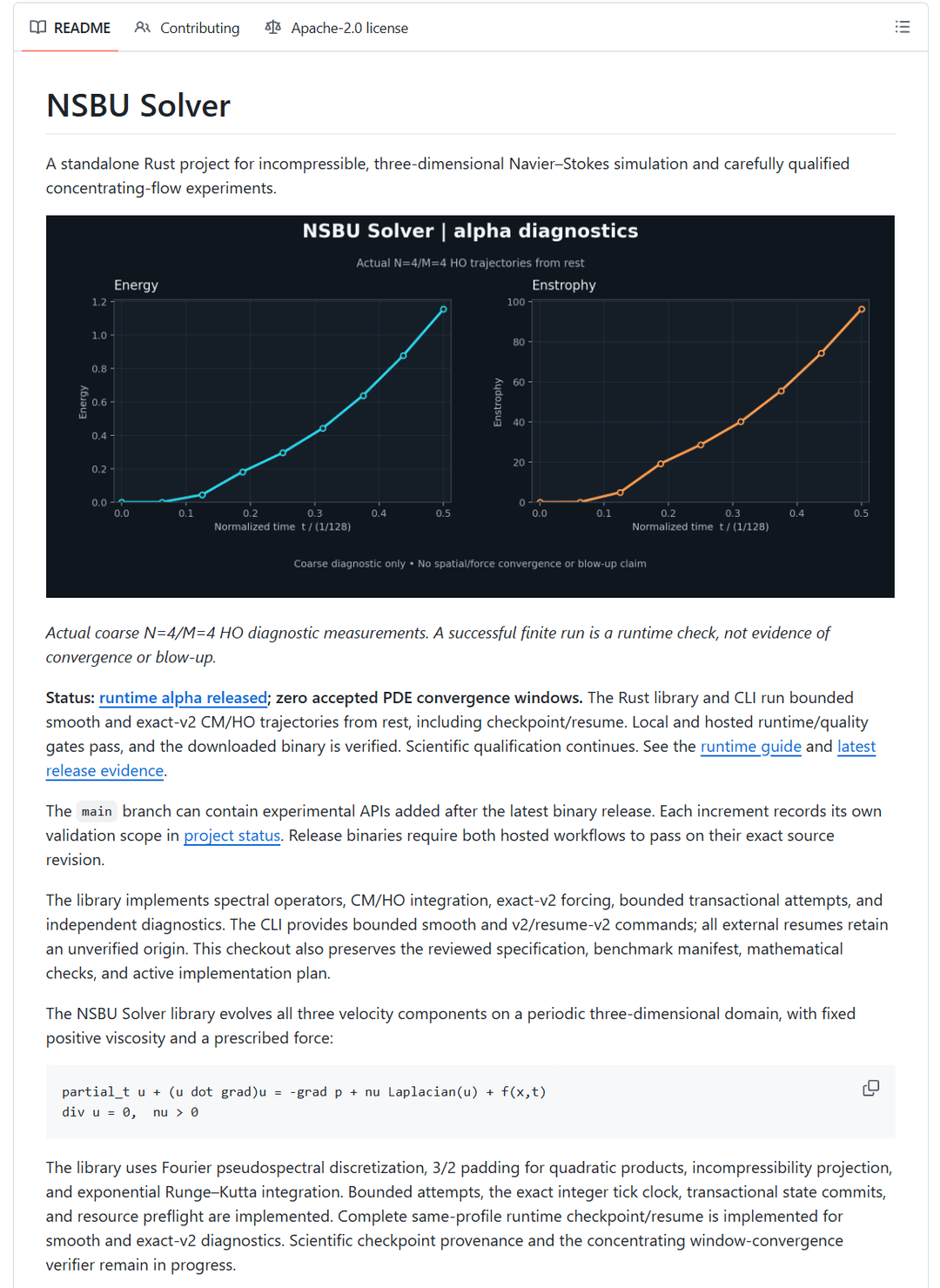
What we did:
On 11 September 2026, Niva Platforms released the NSBU (Navier-Stokes Blow-Up) Solver, an open-source Rust project for incompressible three-dimensional Navier-Stokes simulation with carefully qualified concentrating-flow diagnostics, at runtime alpha (alpha-20260911-2). The library implements Fourier pseudospectral discretization on a periodic three-dimensional domain, 3/2 padding for quadratic products, incompressibility projection, and exponential Runge-Kutta integration for both CM (composite) and HO (high-order) trajectories. Runtime safeguards include exact integer tick clocks, resource preflight, transactional state commits, and same-profile checkpoint/resume. Independent Python and Rust reference implementations provide pointwise exact-v2 evaluations, direct-DFT fixtures, and 80/120-digit arithmetic comparisons. The first concentrating case is similarity-mms-v2, a manufactured prescribed-force problem in a periodic three-dimensional box. Every diagnostic report identifies UnqualifiedDiagnostic and enumerates qualifications that remain open.
GitHub release available at https://github.com/nivatechnologies/nsbu-solver.
Headline numbers:
- Runtime alpha binary verified against detached SHA-256 checksums, Linux x86_64 GNU/glibc, roughly one to two minute diagnostic runs on measured host. Diagnostic families cover space, time-step, and CM/HO comparison trajectories on grids 4/8/12.
- Independent Python reference produces pointwise v2 scalar/jet evaluations and direct-DFT fixtures at 80 and 120 decimal digits. From-rest N=4 smooth trajectories evolved with temporal and arithmetic refinements. Coarse concentrating diagnostic reaches the first endpoint from rest with both methods.
- Rust benchmark library provides independent v2 scalar/jet evaluations and a bounded sampled force provider. Final package verification passed locally and in hosted CI. First Rust concentrating diagnostic reaches 1/256 from rest on N=4.
- Design reservations: 128³ grid requires 1.25 GiB base, 256³ requires 9.98 GiB, 512³ requires 79.68 GiB, 1024³ requires 636.71 GiB. These are conservative reservations excluding FFT plans, provider scratch, diagnostic grids, I/O, and allocator overhead.
- Zero accepted PDE convergence windows. The alpha is diagnostic-only. Runtime completion is a runtime check, not evidence of convergence or blow-up.
Why it matters:
- The scarce resource is verification and understanding, not proof generation: Terence Tao's address at ICM 2026 called out this dynamic explicitly. AI has driven proof-generation cost near zero while the community’s capacity to verify, digest, and canonicalize those proofs has not scaled. NSBU contributes to the verification layer directly. Open-source, Apache-licensed, independently reproducible, with reference implementations in two languages and arithmetic checks at 80 and 120 decimal digits. The community can run, inspect, and extend it without a multi-million dollar compute budget or hundreds of billions of token usage.
- Runtime completion is not scientific qualification: A bounded solver run that completes on a coarse grid is a runtime check. It is not a proof of convergence, not a resolution of a singular limit, not evidence of finite-time blow-up, and not a validated numerical trajectory. Every NSBU diagnostic specifies UnqualifiedDiagnostic, enumerating any qualification channels that remain (e.g., space, time, force-sampling, arithmetic, pressure, balance, residual). The distinction is structural, not cosmetic or editorial. This is the register that classical numerical analysis has always required, that the current AI-driven (compression-and-scale approach) moment does not enforce.
- Deterministic runtime, transactional commits, and independent verification are the architectural family Niva builds in: NSBU shares the operational commitments Manifold makes in the physical AI setting. Fourier pseudospectral operators on governing equations, exact integer clocks, bitwise-reproducible outputs, resource preflight, independent Python and Rust reference implementations at higher arithmetic precision than the runtime. Coupling and correctness live in the architecture, not in a verification layer wrapped around a probabilistic core. The classical numerical version and the physical AI version are the same architectural discipline applied at different layers of the stack.
- The Clay problem and current AI-generated proofs are not resolved by this work: The Clay Mathematics Institute continues to list the Navier-Stokes existence and smoothness problem as unsolved. NSBU does not audit OpenAI’s 08 September 2026 announced proof, does not audit the Buckmaster-Alpöge Euler and related blow-up proofs published the same day, and does not assert the prize is settled. The similarity-mms-v2 benchmark is a manufactured concentrating-flow problem, not a reproduction of any published claim. NSBU's release supplies the community with independent classical numerical infrastructure at a moment when multiple high-profile claims deserve public, reproducible tooling for independent examination.
Bottom line:
Niva’s NSBU is an open-source Rust runtime for incompressible three-dimensional Navier-Stokes simulation with independently verified reference implementations, released at diagnostic-only alpha. It does not resolve the Clay Millennium Prize problem, does not audit any existing proof, and reaches zero accepted PDE convergence windows in this alpha. It contributes deterministic classical numerical infrastructure to the community at a moment when the verification-and-understanding layer of the field is the scarce resource. The architectural discipline is the same that Niva applies to our Manifold platform: deterministic runtime, transactional commits, independent reference computation, and explicit separation between what the runtime does and what has been scientifically qualified.
GitHub link:
Niva’s NSBU Solver, released under Apache 2.0 license, available on GitHub. https://github.com/nivatechnologies/nsbu-solver