October 25, 2026 · News
FABTECH 2026: Niva participates in AWS Professional Program, anchoring runtime physics-native AI against 'Physical AI' on the show floor
About FABTECH
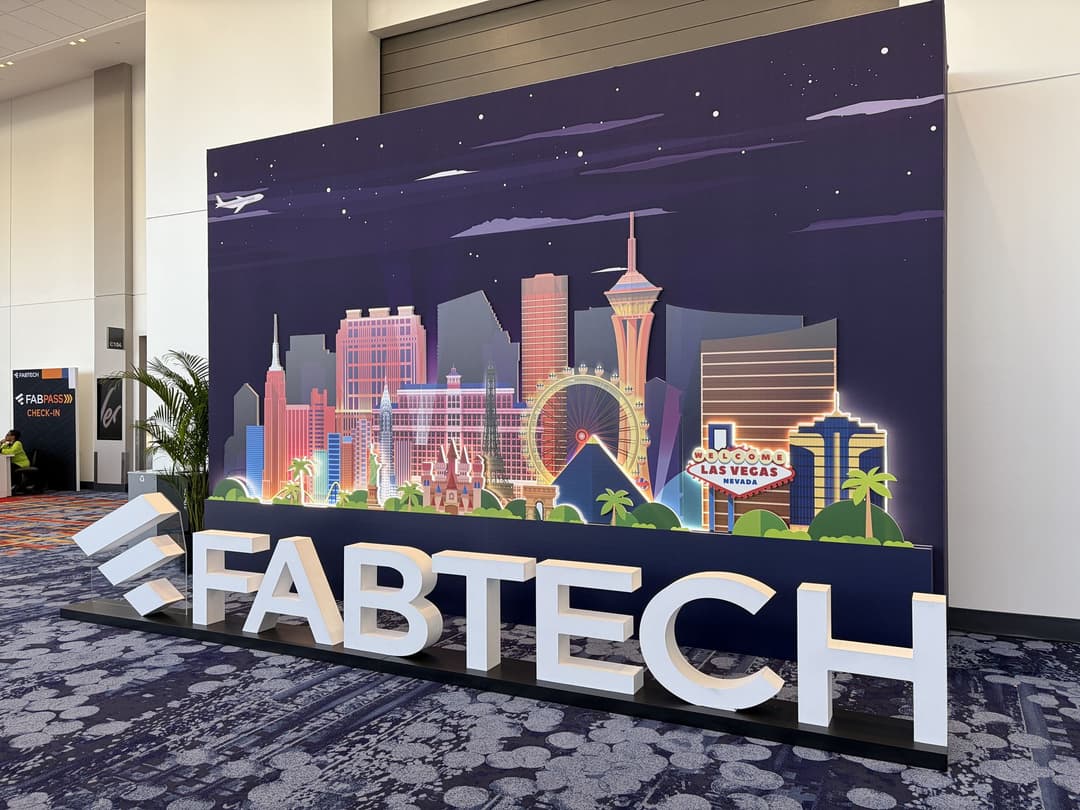
Niva attended FABTECH 2026, which ran from 21-23 October 2026 at the Las Vegas Convention Center. FABTECH is North America’s largest metal forming, fabricating, welding, and finishing event, drawing more than 31,000 attendees and 1,500 exhibitors, co-produced by the American Welding Society (AWS) alongside SME, FMA, and PMA. The 2026 edition covered the full category breadth of the industry, highlighting robotics, AI for welding and manufacturing, additive manufacturing, finishing, stamping and press automation, alongside the AWS Professional Program of welding research sessions.
The Niva team had an opportunity to engage in academic discussions with researchers from NASA, Oak Ridge National Laboratory, Ohio State, University of Maryland, EPRI, and others. As well as technical and partnership engagements with FANUC, Yaskawa, Kawasaki Robotics, HD Hyundai Robotics, ESAB, Lincoln Electric, and Pemamek. The engagements provided insights as to the direction of academic research and commercial application, the persistence of challenge areas, and limitations of current solutions.
Research presented at AWS Professional Program
The AWS Professional Program covered several research threads defining the current direction of the field. In-space welding has moved from feasibility to active process development through NASA’s thermal-vacuum laser beam welding and Sandia’s vacuum chamber lunar-regolith trials. Dissimilar metals, hydrogen susceptibility in high-strength and pipeline steels, and Wire Arc Additive Manufacturing (WAAM) moving into pressure-service qualification each anchored multiple sessions. Across the AI and modeling sessions, including Oak Ridge’s computational alloy design and process modeling work for additive manufacturing, physics-informed and physics-constrained approaches were converging as the direction the research community pointed toward, rather than pure data-driven methods.
GMAW Welding Demo
Ahead of FABTECH, Niva released a new interactive browser demo for Gas Metal Arc Welding (GMAW), demonstrating per-weldment pass optimization with runtime thermal forecasting.
The demo runs a two-part multipass GMAW scenario in which both weldments show identical point-pyrometer readings at pass 5, 304 °C, while their interior thermal states diverge due to a 3-minute arc-off on Part B between pass 4 and pass 5. Under the standard procedure, Part B’s pass-6 arrival temperature reaches 229 °C, exceeding the 204 °C procedure limit. Manifold’s per-part forecast instead holds Part B for 90 seconds, releases at 201 °C under the limit, and lets Part A proceed without delay. The decision pattern (surface readings agree, interiors do not, per-part forecasting enables differential release) generalizes to multipass heavy-plate, pipeline, HSLA, and clad welding.
The online demo is available at:
https://www.nivatech.io/demos/gmaw-welding.
Recurring themes across the showroom floor
Across both commercial halls at FABTECH 2026, several patterns in how Physical AI was being represented, pitched, and architected stood out. Four patterns held consistently across booths, vendors, and categories throughout the show. Together they describe how the industry is currently attempting Physical AI, the gap between how the term is marketed and what the underlying architectures actually enable, and the shape of the problem a different approach would need to address.
Theme 1 - Physical AI and basic automation compete for mindshare: Across FABTECH’s three days, two distinct buyer segments operated in overlapping aisles with fundamentally different needs. The first segment arrived in search of next-generation Physical AI: closed-loop control, augmentation of expertise against workforce attrition, requirements for high accuracy, low tolerance, optimized and repeatable outcomes. The second segment arrived in search of basic operator aids: physical controllers with dials for speed, time delay, width, oscillation, and feed, with no connectivity, no SCADA integration, and no software layer underneath.
Both needs are legitimate, but reveal an interesting dichotomy that is emerging across the industry. Both approaches were being pitched by vendors whose language stretched across the gap between them. The term ‘Physical AI’ carried the load for that stretch. On one booth, the term named digital twins. On another, off-the-shelf vision components. On a third, bespoke learned vision models. On a fourth, a rebadged PLC. Buyers with the first segment’s needs encountered the same vendor language as buyers with the second segment’s needs. The language carried no architectural distinction to resolve what each vendor actually offered, and more significantly, what the customers actually wanted.
Theme 2 - Fabrication and welding AI as trained models: AI products marketed for fabrication and welding at FABTECH, with limited exception, came from the same architectural family - trained models.
Reinforcement learning stacks, transformer backbones, Vision-Language-Action (VLA) models, and learned-component digital twins appeared across booths and application scenarios. These architectures share a defining property that shapes what they can and cannot address. Each learns from a training corpus, producing outputs whose accuracy and reliability are highly dependent on how close production conditions match the training distribution. Behavior outside that distribution is not characterized by the model’s design, and tends to fail catastrophically under such conditions.
For example, VLAs such as Physical Intelligence, OpenVLA, or SimpleVLA-RL might operate at 60-90% accuracy on fine-tuned, in-distribution tasks. Narrow out-of-distribution tasks (novel scenarios, materials, environments, zero-shot) drop precipitously, to accuracy ranges of 6-10%. Likewise, classical pipeline approaches (CuRobo and RRTConnect) with ideal grasp and scene environment characterization provide 53-67% accuracy, yet fall to 19-31% when provided only partial point cloud information. Digital twins can achieve up to 90% accuracy on Franka Emika hardware for example, but only when performed after post-validated motion planning, dropping to 35-55% accuracy when not validated beforehand.
This aspect is significant in the fabrication and welding domain, where application requirements and conditions evolve continuously, often from multiple directions at once. Where new alloys enter production, consumable lots shift chemistry, joint geometries change by work order and simple variance, hydrogen uptake drifts with seasonal humidity, etc. These types of process envelopes extend into regimes the training set did not sample, and therefore cannot ‘understand’ or solve with any level of accuracy. For a trained model to govern production in these conditions, the model must either be able to generalize beyond what it was trained on, or operate only within the trained distribution and surface boundary that was pre-defined. Across the FABTECH show floor, neither capability was demonstrated with any confidence.
Theme 3 - Vision-based AI is dominant, nearly exclusive: Across FABTECH, the sensing architecture under Physical AI, inspection, and process evaluation stacks was almost exclusively vision-based. RGB cameras served as the primary sensor in nearly every stack observed. Infrared cameras appeared occasionally. Profilometers and acoustic sensors appeared rarely, and when they did, they operated in supporting roles to the RGB camera rather than as primary sensing modalities.
The question this architecture does not answer is: what can actually be assessed, let alone inferred, from the visual field alone?
Many of the defects, characterizations, and physical states that determine whether a weld is sound sit below the surface or inside the material. Fusion depth and penetration. Internal cracking. Subsurface porosity. Intermetallic compound (IMC) layer thickness, phase, and morphology at dissimilar interfaces. HAZ grain size and microstructure or HAZ micro-fissures. Oxide inclusions and slag entrapment below the cap. Root-side defects on single-sided welds. Carbon migration across dissimilar joints. Interfacial bond quality in solid-state joints. Hardness distribution through the fusion zone and HAZ. Even factors such as residual stress and predicted distortion or spring-in cannot be characterized by visual inspection alone, until the defect has already occurred.
None of these are observable at the surface by a visible-light camera. Most are not resolvable by any passive sensor, visible or otherwise. For a Physical AI stack built on RGB vision to characterize or control the physics that determines part integrity, the stack would need to either reach that physics through another modality it does not possess, or infer it from surface signals that do not carry it. Neither path appeared in the demonstrations observed. At best, the learned solutions, using vision, attempted to predict what will likely happen based on historical or training data - without understanding what is actually happening physically.
Theme 4 - Major players demonstrate basic attempts at Physical AI: Not every Physical AI demonstration on the floor came from a startup or AI specialist company. Several major robotics manufacturers presented their Physical AI control stacks to a steady stream of attendees, but revealed limitations in their approach.
In one good example, a major robotics player provided a demo using a Jetson Orin Nano paired with an Intel RealSense RGB-D camera, both well-matched to edge deployment and credible as a sensor-and-compute pairing. The software was a pretrained vision pipeline, based on Ultralytics YOLO, delivering object detection, instance segmentation, and pose estimation, trained on general-purpose datasets like COCO and ImageNet, with real-time inference on that hardware.
Each component has credible applications in research and even commercial application, but represents an initial foray into the world of Physical AI, with use of off-the-shelf capabilities that can be stood up in quick succession.
It is revealing that major robotics companies presented demos at the premier welding and fabrication event in North America that would have been more appropriate to a university program or pre-funded start-up. Fundamentally, the presentations were of general-purpose vision models, pretrained on consumer-domain imagery, running on edge compute, with no physics layer underneath and no deterministic foundation to enforce what probabilistic layers cannot.
The assembly carries no capability to characterize the physics of a weld, a joint, or a motion event. It provides no mechanism to guarantee what it will or will not do (let alone what it can or cannot do). The approach depends entirely on what the training data represented, and on the degree to which production conditions match the training set. Under a strict reading of the term, the demonstration is not Physical AI; under a loose reading, the term carries so little engineering content that any assembly of sensors and a model qualifies. The gap between what many demonstrations showed and what control of a physical process actually requires is architectural, not incremental. The gap is… significant.
Niva’s approach represents a different class
The four themes converge on a single architectural requirement: a foundation that can characterize and control the physics top-side sensors cannot see, in regimes the training corpus does not cover, with guarantees that hold outside the distributions the trained models were fit to. Niva’s Manifold platform is built to that range of requirements, while providing long-term planning horizons spanning to days and weeks, maintaining incredible accuracy to machine precision, while producing a complete audit trail based on every sensor input and constitutive physics calculation.
Manifold computes governing physics from first principles against live sensor data, not patterns from a training corpus. The computation is deterministic end-to-end: identical inputs produce identical outputs, and every result traces to the physics that produced it. The physics is coupled in real-time, not frozen then stitched together, with multiple domains solving together against a single live world state refreshed every 20 milliseconds. The world state is live, built from the sensors and materials already present in the cell, not reconstructed offline from idealized configurations or parameters.
These architectural choices translate into problem domains conventional stacks structurally cannot address. For dissimilar-metal BIW joints, Manifold computes coupled Fe-Al parabolic growth, CALPHAD stable-phase selection, oxide displacement, and Marangoni weld pool physics as one system, predicting IMC thickness, Al₂O₃ fraction at the fusion boundary, and galvanic current ahead of each weld. For HSLA pipeline and heavy plate under restraint, Manifold runs McNabb-Foster hydrogen trapping, Oriani equilibrium, stress-driven H migration, Koistinen-Marburger martensite kinetics, and Goldak thermal history together, predicting diffusible hydrogen at the martensitic HAZ sub-boundary, CGHAZ hardness, and HIC susceptibility margin for the actual CE and restraint. In both cases, the physics Manifold computes is the physics the sensors cannot measure and the training corpus cannot represent.
This is not a better point solution than demonstrated on the FABTECH floor - it is a different foundation for understanding, optimizing, and controlling physical processes. Point solutions, learned models, and visualization layers address a bounded set of problems within the architecture they inherit. A deterministic, runtime, coupled multi-physics foundation addresses a different class of problems, particularly those that remain structurally unresolvable by trained models and vision sensors. The vendors Niva engaged with at FABTECH are not competitors in the traditional sense; in fact, many are potential customers, able to augment their existing products with Manifold, benefiting from the physics certainty their architectures were never designed to provide.
What’s next for Niva?
Niva has been invited to the World Modeling for Physics workshop (28 February to 5 March 2027) at the Aspen Center for Physics, engaging a focused community of roughly 70 participants from machine learning and the physical sciences, organized by Yann LeCun, Shirley Ho, Julia Kempe, and Randall Balestriero. The workshop presents an incredible opportunity to engage with leading minds and voices in the world model community, discuss native determinism, and architectural affordances created when grounded in constitutive physics. On the fabrication and welding side, follow-ups from FABTECH continue across robotics, welding, automation, and research partners. Commercial engagements from FABTECH and prior conferences continue to move apace across primes, partners, OEMs, and research institutes.