October 19, 2026 · Demos
Demo: GMAW Welding, per-weldment pass optimization with runtime thermal forecasting
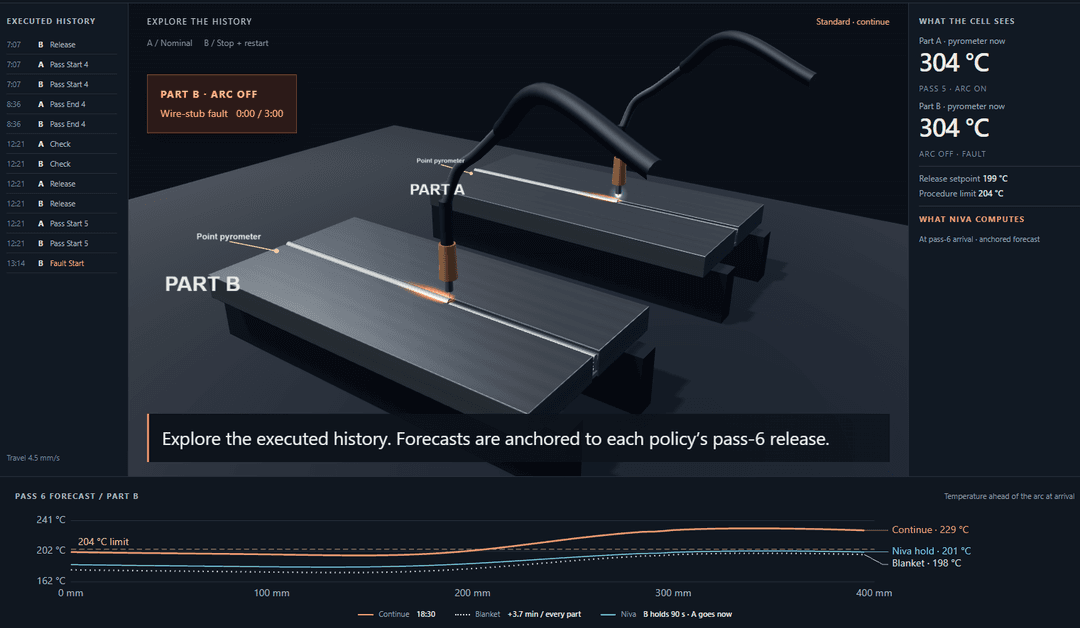
Niva's GMAW Welding demo is live on the Demos page, released to coincide with FABTECH 2026 in Las Vegas - the largest metal forming, fabrication, welding, and finishing expo in North America.
The demo, a web-based example of Manifold's capabilities, runs a two-part multipass GMAW scenario in which both weldments show identical point-pyrometer readings at pass 5, 304 °C, while their interior thermal states diverge. Part A followed a nominal arc history. On Part B, a wire-stub fault caused a 3-minute arc-off between pass 4 and pass 5. The demo exposes the pass-6 release decision under three release policies: continue on the standard procedure, apply a blanket hold on every part, or let Manifold decide per part.
Manifold is Niva's physics-native, end-to-end deterministic world model, with sub-20 ms latency and 60 Hz refresh, edge-deployable on Jetson-class hardware. In production welding deployments, it couples thermal transport, weld pool fluid dynamics, arc physics, phase transformation kinetics, hydrogen diffusion with trap-site accounting, intermetallic growth, and residual stress in a single runtime state, fast enough to act while the process physics is still actionable on the tool.
The demo build is a reduced representation of that platform. It solves constant-property conduction in a solid plate so the decision structure can be presented clearly in the browser. Latent heat, deposit activation, weld pool flow, residual stress, and metallurgy are not resolved in this build. The groove geometry and deposited beads are presentation elements. Pass-6 temperature forecasts evolve the background thermal field without the heat of pass 6. The scenario is a computed illustration of the decision pattern Manifold applies when surface sensors agree and interiors do not; replaying recorded welds with instrumented data is the next step on this demo track.
What the demo does
- Side-by-side scene showing Part A (nominal arc history) and Part B (3-minute wire-stub fault between pass 4 and pass 5), both at 4.5 mm/s travel over a 400 mm pass length.
- Executed-history timeline with per-pass start, end, release, and check events, plus the fault event on Part B, and jump controls to any point in the sequence.
- Point-pyrometer readouts for both parts at the current time, with pass 5 showing the identical 304 °C surface reading that drives the demo's central contrast.
- Pass-6 temperature forecast ahead of the arc for Part B, plotted along the 400 mm pass length, under three release policies: continue on the standard procedure, blanket hold on every part, or Manifold's per-part decision.
- Procedure limit (204 °C) and release setpoint (199 °C) overlaid on the forecast, with pass or fail indication against the limit for each policy.
- Reveal-interior and cutaway controls that expose the computed background thermal field beneath the presentation geometry.
Why this matters to welding engineers and fabricators
Multipass GMAW procedures release the next pass based on surface measurements: pyrometer or thermocouple readings at defined points on the weldment, checked against procedure setpoints and interpass limits. When the surface measurement matches between two parts at the same point in the pass sequence, procedure releases both for the next pass on that basis.
Arc-history divergence can break that equivalence. A stop-and-restart event in a prior pass shifts the interior thermal field in ways the surface reading has already dissipated. In the demo scenario, both parts arrive at pass 5 showing 304 °C at the point pyrometer. Part B's interior, loaded by the 3-minute arc-off and subsequent restart in the pass 4 to pass 5 window, carries residual bulk heat that Part A's does not. At pass-6 arrival, the computed temperature ahead of the arc on Part B is 229 °C under the continue policy, exceeding the 204 °C procedure limit. A blanket hold on every part brings Part B to 198 °C but costs 3.7 additional minutes per weldment regardless of whether the part needed it. Manifold's per-part forecast holds Part B for 90 seconds, releases it at 201 °C under the limit, and lets Part A proceed without delay.
Interior-state divergence under arc-history variation is a recurring concern in multipass heavy-plate, pipeline, High-Strength Low-Alloy (HSLA) steels, and clad welding, where delayed hydrogen cracking, Heat Affected Zone (HAZ) hardness excursions, phase-transformation kinetics, and residual-stress accumulation all depend on thermal history the surface pyrometer does not reveal. The decision pattern shown here, surface readings agree, interiors do not, per-part forecasting enables differential release, generalizes to those processes.
The scenario is a computed illustration of that pattern on a reduced physics build. It is not a validation of Manifold against instrumented production welds; that validation is the next step on this demo track.
Try it out
The demo runs in the browser at https://www.nivatech.io/demos/gmaw-welding.
Other demos are available at https://www.nivatech.io/demos.
One platform, multiple domains
GMAW Welding is a single application focus of what Manifold can perform, and part of Niva’s Fabrication Solutions suite. The same architecture runs runtime cure control on composite press cycles, satellite thermal analysis on the ground or on the spacecraft, polymer certification under mixed recycled content, and warm-start ADCS recovery after a bus shutdown in under 2 minutes. Different domains, same platform: constitutive physics that runs continuously, deterministic solvers producing every state transition, with sensor data refining the world model, able to run in the cloud or edge deployable on your production line, spacecraft, robot, vehicle, or in the lab.