April 19, 2026 · News
Closing the coupling chain: Applying Manifold's runtime physics to orbital state prediction
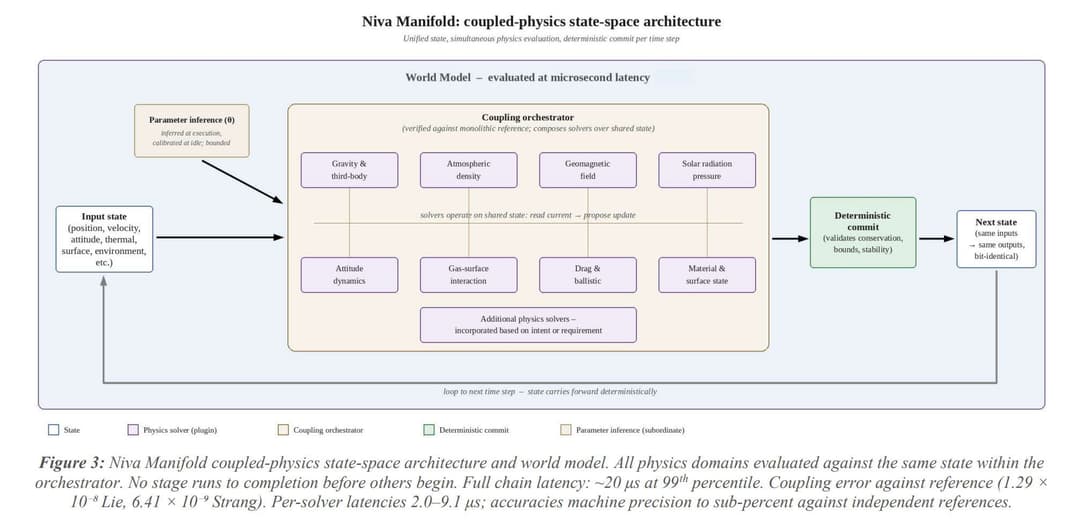
Niva published a technical analysis of object-specific orbital state prediction in VLEO and LEO, identifying the architectural gap between current state-of-the-art staged-pipeline integration and runtime coupled-physics evaluation. Manifold is introduced as a coupled multi-physics architecture with deterministic commits, designed to resolve the prediction physics end-to-end at runtime rather than absorb it into fitted parameters.
The coupling chain
Object-specific orbital prediction depends on a physics chain: material exposure drives surface evolution, surface evolution changes gas-surface interaction, gas-surface interaction sets the drag coefficient, drag coefficient and attitude-dependent cross-section produce ballistic behavior, and ballistic behavior combined with the thermospheric density field produces orbit realism. Each link is supported by mature research and quantitative validation. None of it is closed as a continuous runtime process for an operational catalog object.
The most complete published integration (Demiralay and Karabeyoglu, IAC 2025) operates as a staged pipeline: each physics domain runs to completion against frozen inputs from the previous stage, with handoffs between phases. The result is sequential-additive coupling, not live state-space coupling. The architectural pattern is a conventional multi-physics workflow, applied to orbital prediction. It doesn’t work.
Manifold takes a different approach. All physics domains evaluate against the same state within a coupling orchestrator, with deterministic commits governing every state transition. The unified state is the precondition for coupling: separate orbit filters, attitude filters, and density models exchanging summary fields on fixed schedules cannot resolve effects that span domains within a single time step.
Manifold’s approach
- Per-solver P99 latency ranges from 0.46 µs (drag-cannonball) to 9.10 µs (atmospheric density).
- The full orbital-attitude-environment evaluation chain closes at approximately 20 µs at the 99th percentile, orders of magnitude below the 10 ms threshold for closed-loop control.
- Six of seven core solvers verified at machine precision against independent references. Gravity-zonal perturbations (J2 through J6) align with Vallado's formulation to 4.3 × 10⁻¹⁶ relative tolerance. The IGRF-14 geomagnetic field solver produces zero nanotesla deviation from the NCEI reference across four test points.
- Operator-splitting coupling verified against a monolithic tightly-coupled reference: temperature error 1.29 × 10⁻⁸ (Lie) and 6.41 × 10⁻⁹ (Strang). The 2.02× ratio matches theoretical first-to-second-order improvement. Isothermal limit recovers single-physics results to 0.011% error.
- End-to-end platform latency is 43 ms, deployable on NVIDIA Jetson-class edge hardware (10 to 130 W TDP) at the same evaluation rate as ground-segment servers.
What this means for the space industry
Ballistic behavior in current operational practice is captured by a fitted ballistic coefficient (B*), a single parameter that absorbs everything upstream: material state, accommodation shifts, attitude-dependent projected area, and atmospheric density model error. A drifting B* over time encodes some combination of physical change and fit artifact, with no way to separate them. Manifold derives ballistic behavior from the coupled evolution of material, gas-surface, drag, and attitude state. A change in predicted drag traces to a specific physical quantity, not to a coefficient without physical interpretation. This is the architectural difference between resolving the chain and approximating its final step.
The runtime requirement is what makes onboard deployment possible. Microsecond per-solver latency on edge hardware enables coupled-physics propagation through bus shutdowns, ADCS warm-start sequences, and other ground-outage windows where current onboard methods extrapolate fitted models through the gap. Determinism, bitwise-identical outputs across repeated evaluations, makes predictions auditable and suitable for operational commits.
The deployment question
The gap between staged-pipeline integration and runtime coupled-physics evaluation lies in the engineering integration, not in the underlying physics or numerical methods. Operator splitting is a mature tool in stiff multi-physics, used in combustion, climate modeling, and reservoir simulation. The contribution is its composition across the full orbital coupling chain at microsecond latency, with deterministic commits suitable for operational use.
The full technical report is available on the Research page: https://www.nivatech.io/research/research-resolving-coupled-orbital-drag-physics-at-runtime-within-a-deterministic-world-model
One architecture, multiple domains
The orbital coupling chain is one instance of a pattern that runs across every domain Manifold serves: a chain of physics that is supported at the component level but not closed as a continuous runtime process. Manifold was built around constitutive physics that runs continuously and a deterministic world model that integrates whatever sensor data is available. Orbital state prediction exercises a slice of that capability. The architecture generalizes wherever runtime coupling, deterministic commits, and edge-deployable performance are required.