April 20, 2026 · Analysis
Research: Resolving Coupled Orbital Drag Physics at Runtime within a Deterministic World Model
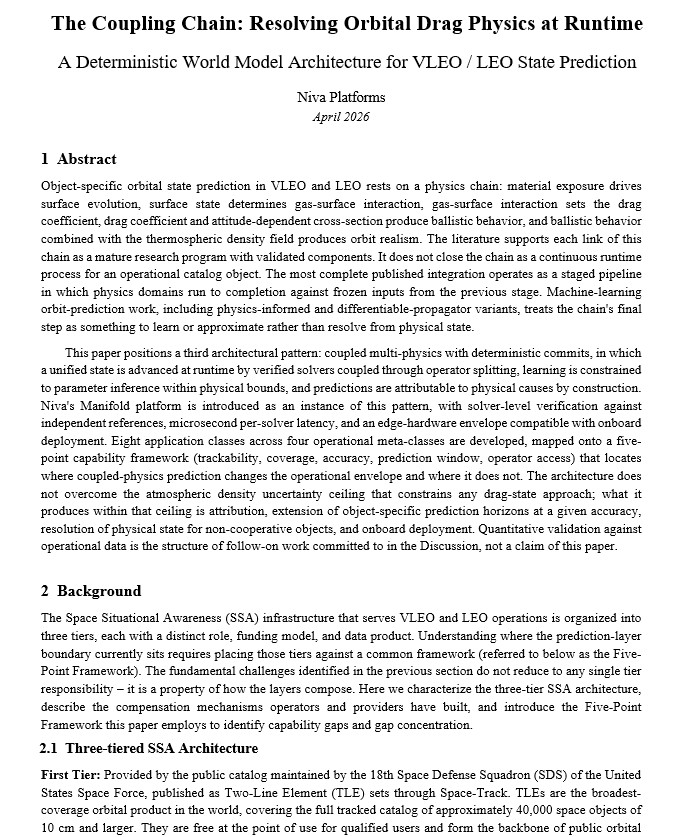
What we did:
Conducted technical analysis on object-specific orbital state prediction in VLEO/LEO, identifying architectural gaps between staged-pipeline integration (current state of the art) and runtime coupled-physics evaluation. Niva's Manifold platform is introduced as a coupled multi-physics architecture with deterministic commits, designed to resolve the prediction physics end-to-end at runtime rather than absorb it into fitted parameters.
Headline numbers:
- Per-solver P99 latency ranges from 0.46 µs (drag-cannonball) to 9.10 µs (atmospheric density). The full orbital-attitude-environment evaluation chain closes at ~20 µs at the 99th percentile — orders of magnitude below the 10 ms threshold for closed-loop control.
- Six of seven core solvers verified at machine precision against independent references. Gravity-zonal perturbations (J2–J6) align with Vallado's formulation to 4.3 × 10⁻¹⁶ relative tolerance. IGRF-14 geomagnetic field produces zero nanotesla deviation from the NCEI reference across four test points.
- Operator-splitting coupling verified against a monolithic tightly-coupled reference: temperature error 1.29 × 10⁻⁸ (Lie) and 6.41 × 10⁻⁹ (Strang), with the 2.02× ratio matching theoretical first-to-second-order improvement. Isothermal limit recovers single-physics results to 0.011% error.
- End-to-end platform latency is 43 ms, deployable on NVIDIA Jetson-class edge hardware (10–130 W TDP) at the same evaluation rate as ground-segment servers.
Why it matters:
- The coupling chain is a runtime problem, not a component problem: Each link of the chain - material exposure, surface evolution, gas-surface interaction, drag coefficient, ballistic behavior, orbit realism - is supported by mature literature. None of it is closed as a continuous runtime process for an operational catalog object. The most complete published integration (Demiralay & Karabeyoglu 2025) operates as a staged pipeline with frozen handoffs between phases.
- Predictions become attributable to physical causes: Ballistic behavior is derived from coupled material, gas-surface, drag, and attitude state rather than absorbed into a fitted B*. A change in predicted drag traces to a specific physical quantity, not to a coefficient with no physical interpretation. This is the architectural difference between resolving the chain and approximating its final step.
- Onboard deployment becomes possible: Microsecond per-solver latency on edge hardware enables coupled-physics propagation through bus shutdowns, ADCS warm-start sequences, and other ground-outage windows where current onboard methods extrapolate fitted models through the gap. Determinism - bitwise-identical outputs across repeated evaluations - makes predictions auditable and suitable for operational commits.
Bottom line:
The gap between staged-pipeline integration and runtime coupled-physics evaluation lies in the engineering integration, not in the underlying physics or numerical methods. Operator-splitting is a mature tool in stiff multi-physics; the contribution is its composition across the full orbital coupling chain at microsecond latency, with deterministic commits suitable for operational use. The architecture does not overcome the atmospheric density uncertainty ceiling that constrains any drag-state approach. Within that ceiling, it produces attribution, extends object-specific prediction horizons at a given accuracy, resolves physical state for non-cooperative objects, and enables onboard deployment.