September 26, 2026 · News
CAMX 2026: Niva releases runtime cure control study and demo for composite manufacturers
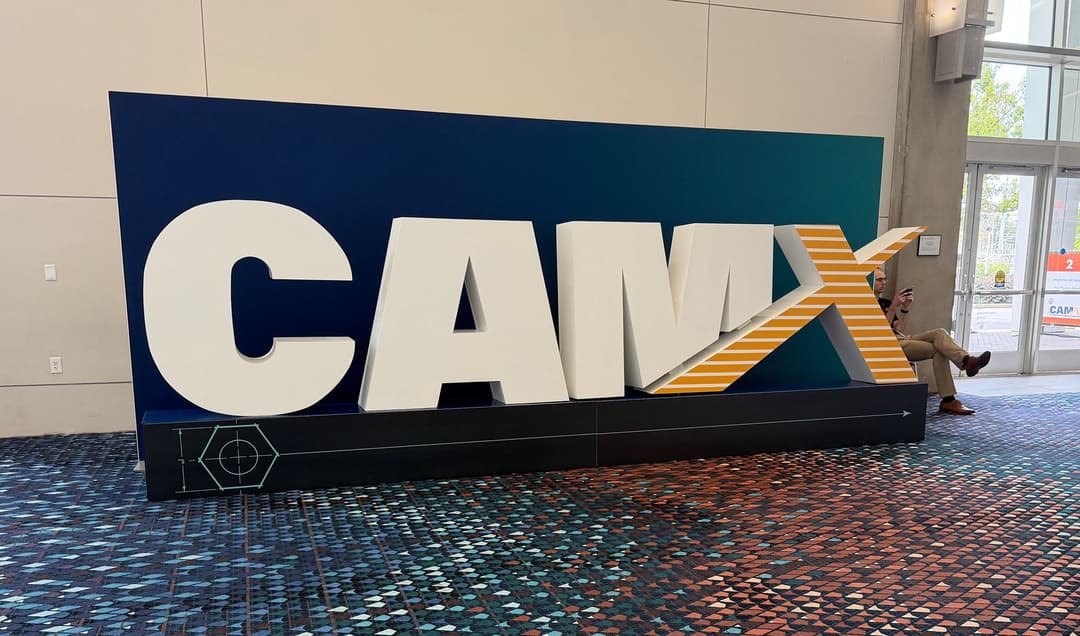
About CAMX
Niva attended the Composites and Advanced Materials Expo (CAMX), which ran from 21-24 September 2026 at the Georgia World Congress Center in Atlanta. CAMX is the premier composites industry event, drawing more than 7,000 attendees, 500 exhibitors, and 100+ technical sessions. The 2026 program centered on aerospace rate ramp, thermoplastic and thermoset, sustainability and circularity, and the emergence of AI and physics-informed modeling in materials and process qualification.
What Niva released at CAMX
In preparation for CAMX, Niva released a technical study and an interactive online demo. The paper, The Recipe Is Not the Part: Recovering Composite Cure-Cycle Margin with Instance-Informed Runtime Physics was released on 21 September, and the interactive browser demo Runtime Cure Control went live the next day. Both were made available to CAMX attendees on the show floor and published to nivatech.io.
The study centered on a blinded 40-instance simulation of thick AS4/3501-6 laminates, starting from a recipe already optimized offline with the same physics. On each load, Niva’s Manifold platform calculated the real-time physics, informed by thermocouple histories, aligned to final soak qualification and safety. Manifold declined unsafe cases and recovered 92.9% of the minutes built into an already “optimized” recipe - with validation that every load was performed based on acceptance criteria, introducing zero new failures.
Extending the same approach from a single instance-informed decision to a full runtime-optimized recipe, Niva produced a composites solution brief demonstrating that the established Hercules-published thick-part cure recipe for AS4/3501-6 could be further safely optimized. The optimization Manifold uncovered was not trivial - cutting median cycle time by roughly 1/3 against the published recipe, from 11.4 hours to 7.5 hours across 200 held-out loads. The performance increase represents a 1.5x throughput gain from the same press with no hardware change, while maintaining physics validity and part safety.
The research study is available at:
https://www.nivatech.io/research/research-the-recipe-is-not-the-part-recovering-composite-cure-cycle-margin-with-instance-informed-runtime-physics
In parallel, Niva also released a new online demo, which replays the 40 loads from the study interactively. The viewer can manipulate the setpoint, view thermocouple traces, alongside laminate interior temperature and the true cure state that Manifold calculated and validated.
The online demo is available at:
https://www.nivatech.io/demos/cure-control
Together, the two artifacts illustrate the same claim: the recipe is not the part. A recipe qualified for the most demanding load in an envelope has traditionally been achieved through conservative approaches, across every load in that envelope. The physics that determines whether a specific load requires that level of conservatism is computable from the sensor data already present, in real time, during the cure. What the recipe treated as fixed becomes conditional, evaluated against coupled physics rather than heuristic and historic thresholds. The gains afforded by real-time physics predictions and optimization are immediate - 1.5x gains on optimized recipes with the same equipment, and in outlier cases, reducing cure cycle time by half.
Engagement across CAMX
CAMX brings together the North American composites community in one venue: aerospace primes and tier-1 fabricators of composite structures for programs like the 777X wing center, the LEAP fan blade, and the F-35 airframe; major prepreg and carbon fiber suppliers that anchor commercial aerospace and defense; autoclave and press OEMs whose installed base runs those cure cycles; the simulation and software vendors that support design and process qualification; and research institutes and academic labs bridging to industry.
Niva's conversations across the show ranged across those participants and players, with follow-ups underway across simulation-and-software partnerships, tier-1 fabrication, materials suppliers routing to R&D, and a key research institute positioned as a potential validation partner.
Observations about reception, since going public
In January 2026 Niva emerged from stealth mode, engaging with engineers, business leaders, investors, industry conferences, and the general public. Since that time, Niva has observed the full range of responses to Manifold across technical and non-technical audiences.
Most reactions fall along a familiar spectrum:
- Immediate engagement and excitement, attaching Manifold to an individual’s specific challenges or use cases.
- Basic questions, trying to understand how the architecture works, how is something ‘physics-native’, what deterministic means.
- Technically adept, structured skepticism testing Niva’s claims, often pattern-matching to conventional AI, digital twins, offline simulation, Machine Learning.
A smaller proportion, consistent across audiences and industries, arrives as flat rejection. The response is not skepticism, which is welcome and rational given the state of AI claims... it is something else.
When presented with technical details about the platform, the architecture, the capabilities, the application to real-world physical processes, even Niva’s pilot work with major companies - the claims are treated as unacceptable before evaluation. That pattern appears to reflect conflict with an established mental model - of what AI is, of how new capability enters an industry, and of what can plausibly have been developed. In each case, Manifold doesn’t just present a poor fit with the mental model, it breaks it.
Ironically, CAMX 2026 listed AI and physics-informed modeling for materials and process qualification among its central themes for 2026. The friction was not about an industry’s openness to a given category, it was about what Manifold represents - a new category of AI, a new paradigm, that fundamentally alters what is possible.
While representing a small proportion of individuals, the flat rejection pattern which occurs is grounded in a disruption of a sometimes rigid mental model. Manifold challenges two sets of foundational assumptions at once, and the combination produces destabilization.
The first challenge is architectural - what AI is or what is AI allowed to be:
- Deterministic and physics-native, computing from governing equations rather than learned patterns, no probabilistic components in the operational path.
- No training data, no fitted approximations, generalizes zero-shot to new materials, scenarios, and configurations.
- No massive datacenter or compute requirements. Runs on commodity edge hardware on the order of $6K, at 60 Hz, under a full 5 GB model footprint.
Under the assumptions the AI discourse is currently organized around, this is a category that should not exist, or more plainly, cannot exist. Manifold represents the antithesis of ‘what AI is’ from an established view.
The second challenge is operational - what is technically and physically possible when controlling physical processes:
- Calculating composite cure in real-time from live sensor data, computing the coupled physics inside the laminate, interior temperature, cure state through thickness and void behavior, elements the sensors themselves cannot measure.
- Verified accuracy against independent analytical references, with constitutive solvers at machine precision or below 0.1% (Fourier thermal 0.08%, Arrhenius 0.09%, Butler-Volmer 0.07%) and coupled multi-physics at L2 relative errors on the order of 10⁻⁸. Not simply accurate, but hyper-accurate, across coupled domains.
- Continuous building of a world state from live data, calculating, predicting, and optimizing complex coupled physics-based actions every few milliseconds, with intervention arriving while the physics is still actionable rather than confirming outcomes afterward.
Depending on the flexibility of the individual’s mental model, underlying assumptions about how industrial processes can be observed and controlled, this level of visibility, accuracy, and speed should not be possible. For others, when the physics, model, and calculations are examined in detail… it all starts to make sense.
Either claim set on its own would be substantial. Together, they describe a shift in what AI is and what operators can now know, and therefore do about the physical processes they operate. For some, the rejection pattern is a rational response to that combination, under the assumptions being applied - it is simply too much to accept.
What Niva’s commercial work, research, and publications ask of someone, whether they accept it or not, is to reexamine the established paradigm and the assumptions that are often treated as a given.
Bold claims require substantial evidence, which Niva has spent much of 2026 releasing. The more fundamental questions about what AI is and what is possible from a physical control standpoint are addressed in detail. Niva recently released a 97 page position paper titled Free Intelligence Economics: Paradigmatic, Technical, and Systemic Shifts in AI Discourse (September 2026), that offers insights, architectural details, taxonomy, and impacts. For the interested, skeptical, or even rejection-minded reader, the paper, along with our companion research papers and demos provide depth that can be evaluated on its own terms.
The position paper is available at:
https://www.nivatech.io/research/research-free-intelligence-economics-paradigmatic-technical-and-systemic-shifts-in-ai-discourse
What's next for Niva?
Niva will be attending The AI Conference (29 September to 01 October 2026) in San Francisco, engaging with the Artificial Intelligence community, continuing to share our breakthroughs and developments. On the composites side, follow-ups from CAMX continue across simulation, fabrication, materials, and research partners. Commercial engagements from CAMX and prior conferences continue to move apace across primes, manufacturers, and research institutes.