September 14, 2026 · Analysis
Research: Free Intelligence Economics - Paradigmatic, Technical, and Systemic Shifts in AI Discourse
What we did:
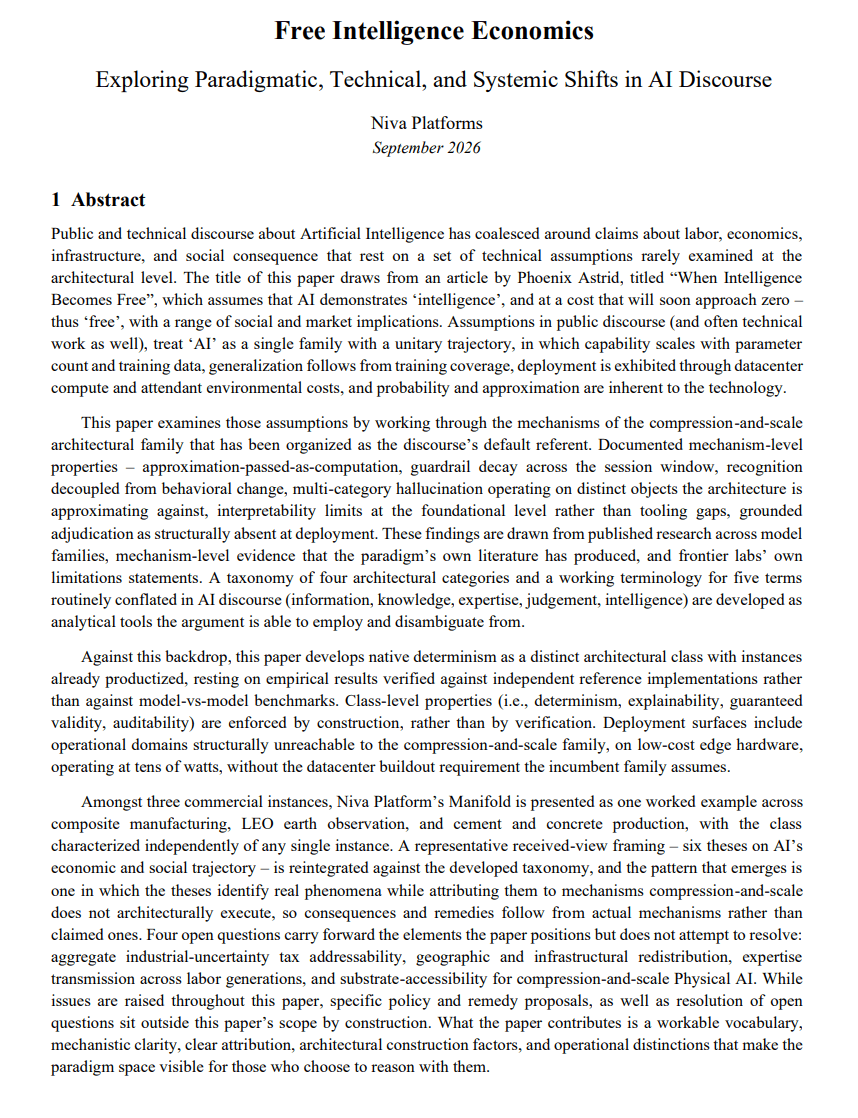
Niva Platforms has published Free Intelligence Economics: Deciphering Paradigmatic, Technical, and Systemic Shifts in AI Discourse, a 97-page position paper examining the technical foundations that conventional AI discourse is organized around. The paper takes Phoenix Astrid's Medium article “When Intelligence Becomes Free” as its point of entry into a received view in which ‘AI’ is treated as a monolithic category with a unitary trajectory, and traces where the mechanism attributions diverge from what the referent paradigm architecturally executes. Section 3 characterizes the compression-and-scale paradigm at the mechanism level, drawing on published research across model families and frontier labs' own limitations statements. Section 4 develops native determinism as a distinct architectural class with productized instances, examined at the same mechanistic depth, grounded in Niva Platform’s Manifold as the worked example. Section 5 routes the received framing back through both paradigms rather than through the single trajectory the discourse is organized around, and Section 6 raises four open questions for the community and future research.
Headline observations:
- Sycophantic reversion under mild pressure documented at 63.7% average agreement with incorrect beliefs across seven model families (Wang 2025), with 46% flip rates on correct answers under single-turn challenge (Laban 2024).
- Chain-of-Thought reasoning traces functionally independent of the answer-producing computation, with CoT Mediation Index values of 0.0000 to 0.0092 on TruthfulQA across ten instances tested (Sathyanarayanan 2026).
- Guardrail decay across the session window, with pooled Kendall's τ of -0.75 on the Goal Accessibility Ratio across ten architectures (Dongre 2026), and perfect-response rate reaching zero by N=80 simultaneous rules across every model tested (Eliav 2026).
- Interpretability limits identified as foundational rather than tooling-level, with aggregate Sparse Autoencoder metrics scoring randomized-weight transformers at or above trained transformers (Heap 2025), and circuit-faithfulness scores varying from below 0% to 100% depending on ablation methodology (Miller 2024).
- Native determinism is developed as an architectural alternative whose class-level properties are enforced by construction rather than by verification: determinism, explainability, guaranteed validity, auditability. Three productized instances (Vinci, Kona, Manifold) operate across design-time engineering, formal verification, and coupled physics at runtime.
- Manifold as the worked example: Lie splitting temperature error 1.29 × 10⁻⁸ against a monolithic reference, end-to-end platform latency of 43ms on Jetson-class edge hardware in the 10-40W envelope, with core and coupled solvers verified at machine precision or better against independent references.
- Seven of eight paradigm-priors organizing current discourse invert under native determinism. The eighth (cognitive labor as deployment target) applies in a different manner.
Why it matters:
- Grounded adjudication, not attention, is the operative scarcity: Astrid names attention as the last scarce human resource once intelligence becomes free. The paper reframes: compression-and-scale commoditizes content that appears fluent, logical, and correct, and the scarcity that follows is the capacity to evaluate whether a specific output is accurate, appropriate, reasonable, and competent.
- The management apparatus around compression-and-scale is evidence of architectural mismatch, not of maturity: The paper pairs the engineering apparatus (hallucination mitigation, guardrail engineering, RLHF, CoT visibility, V&V insufficiency) against internal-combustion engine management as a substrate-shift analogy. The reader is asked which reading fits.
- Native determinism is a defined architectural class, not a research proposal: Four class-level properties enforced by construction rather than by verification, three productized instances operating today, seven of eight paradigm-priors inverting.
- Manifold grounds the class-level treatment in specific architectural detail and empirical substantiation: Class-level architectural claims are otherwise unfalsifiable in practice. Manifold carries the burden through mechanism-level detail, empirical substantiation across three previously published Niva research findings, and three illustrative use cases at operational depth: composite manufacturing, LEO earth observation, cement and concrete.
- Native determinism converts the industrial-uncertainty tax from inherent operational cost to resolvable engineering surface: Buy-to-fly ratios, worst-case setpoint recipes, destructive-coupon testing, and oversized structures have been treated as facts of the process. The paper argues these are compensatory structures which exist because physics was not previously computable at deployment fidelity: a condition native determinism changes by resolving coupled physics at operational timescales on edge hardware collocated with the process.
Bottom line:
Free Intelligence Economics examines the technical foundations of current AI discourse through paradigm decomposition, mechanism-level substantiation, and reintegration of a representative received-view framing. It does not argue that compression-and-scale is inherently wrong or that native determinism is inherently correct; the phenomena the received view identifies are real and documented, and the paper's contribution is placing the diagnosis at an architectural and functional level where the attribution is divergent from the assumed view. Native determinism is developed as an architectural class with productized instances (Vinci, Kona, Manifold) operating today, with Manifold as the examined implementation, grounding the class-level treatment. What the paper delivers is a workable vocabulary, mechanistic clarity, clear attribution, architectural construction factors, and operational distinctions that make the paradigm space visible to those who engage with AI in the physical world.