September 21, 2026 · Research
The Recipe Is Not the Part: Recovering cure-cycle margin with instance-informed runtime physics
What we did:
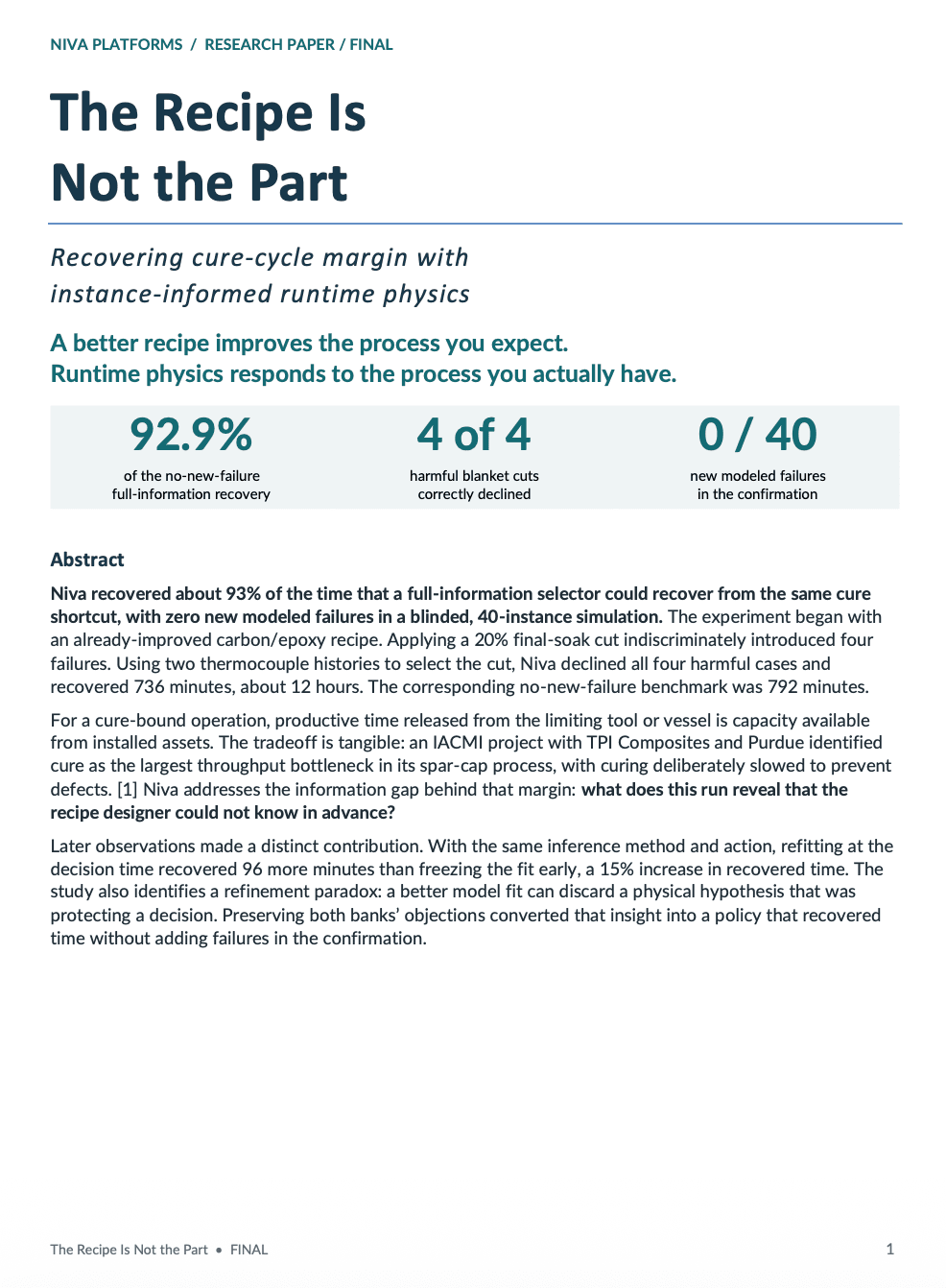
Ran a blinded simulation study asking whether a runtime that observes the actual cure can recover time that an already-optimized recipe has to leave on the table. Starting from a carbon/epoxy (AS4/3501-6) press-cure recipe improved offline with the same physics, we gave Niva's runtime two thermocouple histories and one bounded decision per run: keep the final soak, or shorten it by 20%. Forty fresh thick-laminate instances (54–62 mm, ~8.7-hour cycles) were run under six frozen policies — the incumbent, two blanket cuts, and three instance-informed policies — for 240 completed episodes, scored against six frozen cure, thermal, and recipe-admissibility predicates.
Headline numbers:
- Applying the 20% cut to every run recovers 847 minutes but introduces four new failures; even a 10% blanket cut fails three of forty. A selector with perfect knowledge of every part could recover 792 minutes with zero failures. Niva recovered 736 minutes — 93% of the perfect-information opportunity — with zero new failures, declining all four harmful cuts.
- The decision uses roughly the first half of the run (median 259 minutes in) to decide the second half, from surface and center thermocouples the process already has. No new sensor, vessel, or actuator; the qualified recipe stays in force on every run where the cut is declined.
- Fitting the physical hypotheses at the decision instant, rather than freezing them at 15 minutes, recovered 96 more minutes (15%) with the same method and the same action. All five decisions that differed favored the later fit.
- The study exposed a hazard for any adaptive controller: a better fit can discard the hypothesis that was protecting the decision. The first decision-time policy recovered 646 minutes and caused three failures; a denser hypothesis grid fixed those and introduced two new ones. Preserving objections across two independently retained model banks produced the confirmed result. The full decision costs ~11 seconds per run, about 1/2,800 of the cycle.
Why it matters:
- The margin is structural, and no recipe can remove it: A fixed dwell that must be safe across a manufacturing envelope is sized for the most demanding part in that envelope. Every other part pays for it. The results table shows the trap directly: shorten everything and you fail runs; shorten nothing and you recover nothing. The 792 minutes exist only for a policy that can tell instances apart, and the only place that information exists is the run itself.
- The decision is physical and auditable, not a black-box "faster": In the worked example, the cut and the incumbent reach an identical 178.75 °C peak; peak temperature cannot tell them apart. The runtime declined because every retained physical explanation of the thermocouple history predicted the shortened soak would miss the required conversion — and the completed simulation confirmed it. Each decision traces to named hypotheses, a forecast, and a predicate.
- This is the operating model, not the ceiling: One segment and one cut level were chosen so the value of run-time information could be measured cleanly. The same mechanism applies to any dwell, ramp, or release decision, and press, autoclave, and post-infusion cure all share the question it answers: does the actual history justify changing the hold?
Bottom line:
A good recipe is the starting point, not the last opportunity to improve the process. On forty blinded instances, an already-improved recipe still held recoverable time in 36 of 40 runs and needed all of it in the other four; a blanket cut cannot separate them, and Niva's runtime did, recovering 93% of what perfect information could and failing nothing. The result is a simulation within a declared envelope and one intervention; physical qualification, other segments, and other processes are next. Within that scope it establishes the route from physical inference on the actual part to a justified production decision — the step where physical understanding stays with the operation instead of ending at recipe release.