May 13, 2026 · News
Web Summit Vancouver 2026: Niva brings Manifold's runtime physics to cross-industry audience
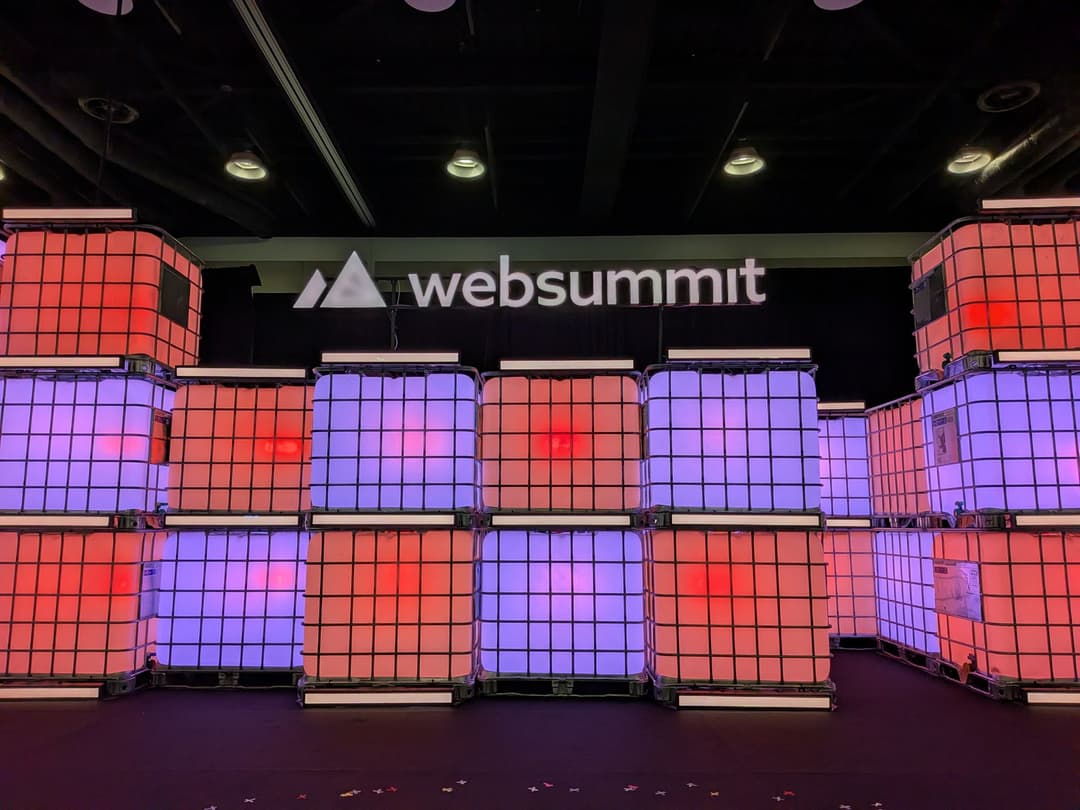
Niva attended Web Summit Vancouver 2026 in Vancouver, BC (May 12-14), with the goal of introducing Manifold to a cross-industry audience after a satellite-industry debut at SATShow in March. The value of the show was in the conversations themselves: the questions that came up, the reception of the evolved positioning, and the interest the platform generated across manufacturing, robotics, materials, and the investor community.
About Web Summit Vancouver
Web Summit Vancouver 2026 ran May 12-14 at the Vancouver Convention Centre, the second edition of Web Summit's North American expansion from its flagship Lisbon event. This year's edition drew 20,235 attendees from more than 100 countries, up nearly 30 percent from 2025. The investor presence was a defining feature of the conference: 768 investors on the ground, a 13 percent increase over last year, including Khosla Ventures, Benchmark, Fusion Fund, Eclipse Capital, Insight Partners, Alumni Ventures, and White Star Capital. The startup program included 1,197 companies, with AI and machine learning leading the sector mix, followed by SaaS, healthtech, and fintech. Major technology exhibitors included Microsoft, AWS, Cloudflare, Google, IBM, and Dell.
Niva's pitch
The positioning Niva led with at Web Summit centered on a single distinction: runtime versus design time. Most physics tooling in industry today operates at design time. Engineers run Ansys or COMSOL before a system is built, before a process is deployed, before a mission is launched. Those runs take hours to days, and once the system is in production the physics tooling is no longer in the loop.
Manifold is different - with new possibilities and applications. Fast, small, hyper-accurate deterministic state space world model. The platform ingests live sensor data, fuses it into a continuously updated world state of the physical world, and computes coupled multi-physics in microseconds, while the system is running on a robot, a spacecraft, a vehicle, or on the manufacturing line. End-to-end latency under 20 milliseconds. World state refresh at 60 Hz. Verified accuracy of 99.8 percent across physics solvers, with error below 10⁻¹⁵ against published references. The platform runs on roughly $6K of edge compute, with a 10 to 40 watt thermal envelope for onboard deployment or in the cloud via API call.
The second pillar of the pitch was coupling. Today's "multi-physics" tools run solvers separately and pass outputs between them as frozen states. The result looks coupled but isn't, and solutions drift when feedback loops matter or when materials and conditions evolve. Manifold runs solvers together, with feedback resolved continuously against live data. Against offline simulation, the NVIDIA stack, VLA models, industrial ML, and classical automation, the combination of genuine coupling and runtime operation on production data remains unique.
The third pillar was the product line: one platform, four products, the same physics engine underneath. Niva Apogee for space and orbital, Niva Manufacturing for process and quality, Niva Robotics for autonomous operations, and Niva Discovery for R&D acceleration. The products are thin layers on top of the same Manifold core, configured to make the platform legible to customers in terms of their own use case.
Cross-industry engagement
Conversations clustered along three vertical lines. Manufacturing and process industries engaged on quality prediction and runtime control on production lines. Robotics teams engaged on contact mechanics, zero-shot performance on novel objects and materials, and the gap between current VLA models and a physics-grounded system. Materials and R&D teams engaged on virtual experimentation, accelerated discovery, and coupled mechanical, thermal, rheological, and electrochemical physics from a single engine. Investor engagement spanned all four product lines, with technical pressure focused on defensibility, hardware economics, and how Manifold compares against the AI architectures already represented in their portfolios.
What resonated with Web Summit audience
Current AI is transformer-based, trained on large datasets, and dependent on datacenter-scale compute. Manifold is none of those. It is a state space and world model architecture. It does not train. It does not pattern-match. It runs on edge hardware in the Orin Nano class, on roughly $6K of compute, with a 10 to 40 watt thermal envelope suitable for onboard deployment. Predictions and actions are derived from coupled constitutive physics, computed in microseconds, with end-to-end latency below 20 milliseconds and a world state refresh at 60 Hz. Verified accuracy across physics solvers is 99.8 percent, with error below 10⁻¹⁵ against published references.
The head-to-head comparison video demonstrating Physical Intelligence's π0.5 against Niva's Manifold on precision manipulation caught attention and generated interest time and again. The task was a raw egg pick-and-place, contact-rich manipulation of a fragile object. PI's model, trained on 10,000 hours of video data across eight robot platforms, achieved 14 percent success, cracking the egg in most interactions. Manifold, with zero training and built-in understanding of contact mechanics and fracture physics, achieved 98 percent success. Manifold operated at 60 Hz on consumer-grade hardware. π0.5 operated at 4.4 Hz on the same class of hardware, well below the 20 Hz minimum for safe, real-time robotics control. The comparison made the difference between physics-grounded prediction and pattern-matched action concrete in a single demonstration.
What's next for Niva?
Niva has been invited to present at We Make Future 2026 in Bologna, Italy, June 24-26. WMF is the largest tech, AI, and innovation event in Europe, expecting more than 73,000 attendees from over 90 countries at BolognaFiere, held under the patronage of the European Commission.
The platform continues to evolve. Since SATShow in March, Manifold has gained lower latency, sharper accuracy verification against published references, additional physics domains, and tighter integration with existing stacks. The positioning continues to sharpen around the same core claim: runtime physics-native AI that augments the systems customers already run, without rip-and-replace, without retraining - maintaining incredible speed, hyper-accuracy, and deterministic physics certainty. The excitement and journey continues.