September 21, 2026 · News
The margins inside composite manufacturing: How runtime physics can recover value from fixed cure recipes
Niva published a technical study of composite cure-cycle margin recovery through instance-informed runtime physics, applied to a thick-laminate carbon/epoxy press-cure process. Starting from an already-improved recipe, the study asked whether a runtime that observes the actual cure can recover time that a fixed recipe has to leave on the table. Manifold — Niva’s coupled multi-physics runtime world model — recovered 93% of the time a full-information selector could have recovered on the same intervention, with zero new failures across a blinded 40-instance simulation.
The margins are structural
Composite manufacturing carries margins throughout its practice: buy-to-fly ratios, oversized structural sections, destructive coupon testing, and conservative process recipes. Each exists because the actual physics of the specific part being made was not previously computable at deployment fidelity. The cure recipe is a clear instance of the pattern. A fixed dwell designed to cover a manufacturing envelope is sized for the most demanding admissible instance in that envelope, and every less-demanding run inherits the same duration. The difference between that common duration and each runs actual requirement is a structural margin, and a larger worst-to-typical spread produces a larger margin. The margin is not a flaw of any specific recipe. It is a consequence of the recipe being fixed at design time, before the actual part exists.
The IACMI, TPI Composites, and Purdue University investigation into wind-turbine spar caps documented the tradeoff directly (Sharp et al. 2020): a program that reduced cycle time encountered thermal instability severe enough that parts were rejected, and the process changes that suppressed the defect returned cycle time toward the original.
What the experiment recovered
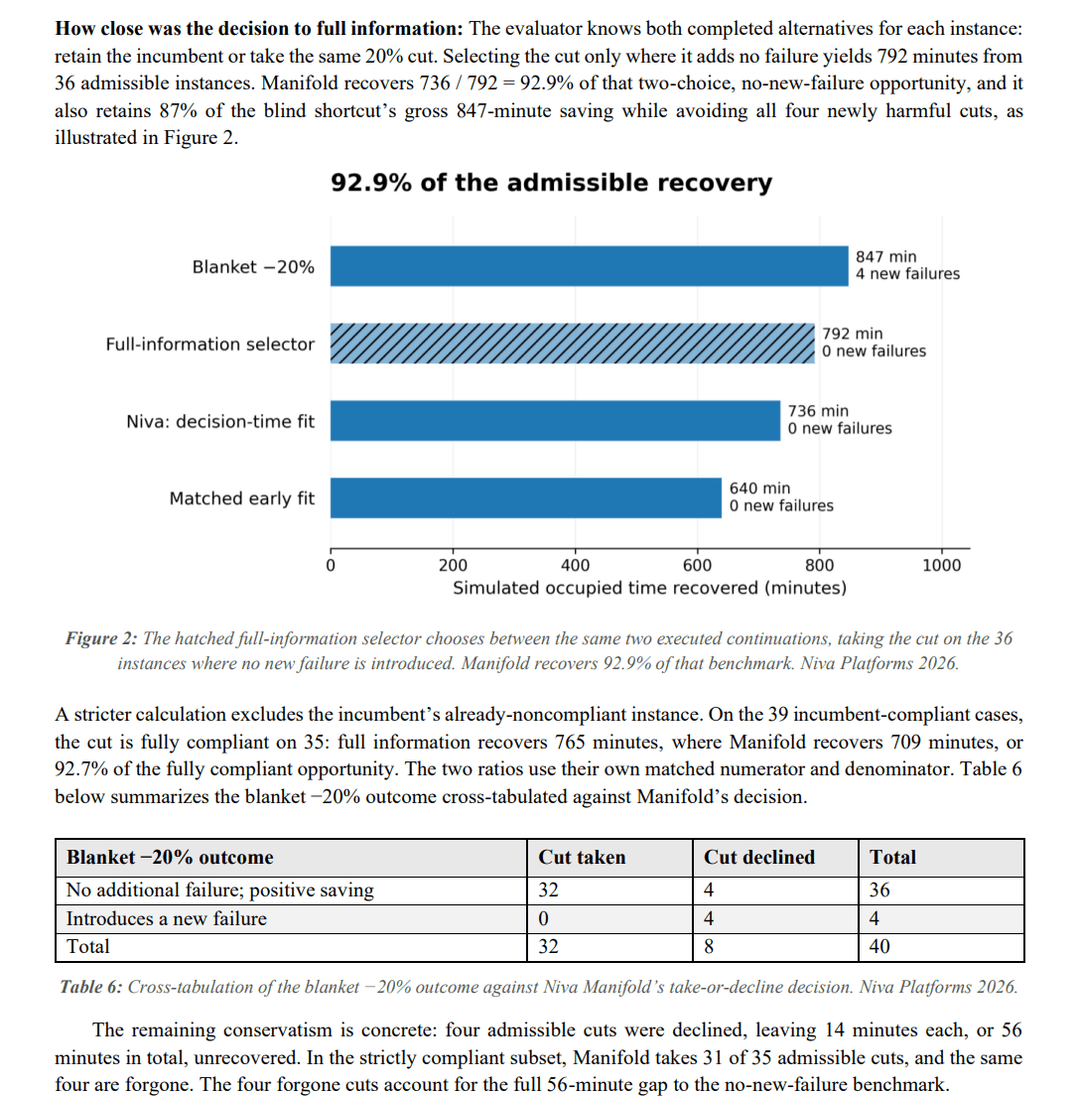
- The 20% blanket cut recovered 847 minutes across 40 runs but introduced four new modeled failures. A 10% blanket cut still failed three of 40. A full-information selector, choosing whether to shorten each run with perfect knowledge, recovered 792 minutes with zero failures.
- Manifold, given two thermocouple histories and one bounded decision per run, recovered 736 minutes — 92.9% of the full-information opportunity — and declined all four harmful cuts.
- The decision uses roughly the first half of the cycle to decide the second, from surface and center thermocouples the process already has. No new sensor, vessel, or actuator; the qualified recipe stays in force wherever the check declines to shorten.
- The full runtime decision cost is approximately 11 seconds per instance in single-threaded execution, about 1/2,800 of the mean cycle. Fitting the physical hypotheses at the decision instant rather than freezing them at 15 minutes recovered an additional 96 minutes, a 15% increase in recovered time.
What conditional runtime physics changes
The cure recipe stops being a single fixed duration and becomes a duration that is ‘conditional’ on evidence from the run — long when the observed history is consistent with a demanding instance, shorter when it is not. The recipe designer prepares the conditional responses; the runtime selects the one the present instance permits, evaluated against coupled physics rather than a heuristic threshold. Each decision traces to a set of named physical hypotheses, a forward evaluation of the shortened continuation, and a predicate that either passes or does not.
For a cure-bound line, the recovered time is the immediately usable outcome: a press, mold, or autoclave released sooner supports another operation. The deployment unit is one sensor-informed authorization point around one known segment of the cycle, with explicit predictions and recorded consequences. The intervention connects to a manufacturer’s existing acceptance criteria through prospective shadow decisions on process records, followed by qualification of the bounded override.
The full technical report is available on the Research page: https://www.nivatech.io/research/research-the-recipe-is-not-the-part-recovering-composite-cure-cycle-margin-with-instance-informed-runtime-physics
One architecture, multiple domains
The cure cycle is one instance of a pattern that runs across every domain Manifold serves: a manufacturing envelope sized for the most demanding admissible case, a fixed response calibrated to cover it, and structural margin left on every less-demanding instance. Manifold was built on a coupled constitutive physics world model, running continuously and deterministically (end-to-end), while integrating available sensor data, materials information, and process details. Manifold calculates coupled physics at runtime, predicting what will happen, and how to meet specified objectives, within the control loop of integrated systems (e.g., SCADA, DCS, etc.). Cure-cycle margin recovery exercises just a slice of that capability. The architecture generalizes wherever the compensatory margin is a structural artifact of design-time practice, and the information required to reduce it exists only inside the run.