August 28, 2026 · News
SmallSat 2026: Niva defines physics-native understanding and control for space operators
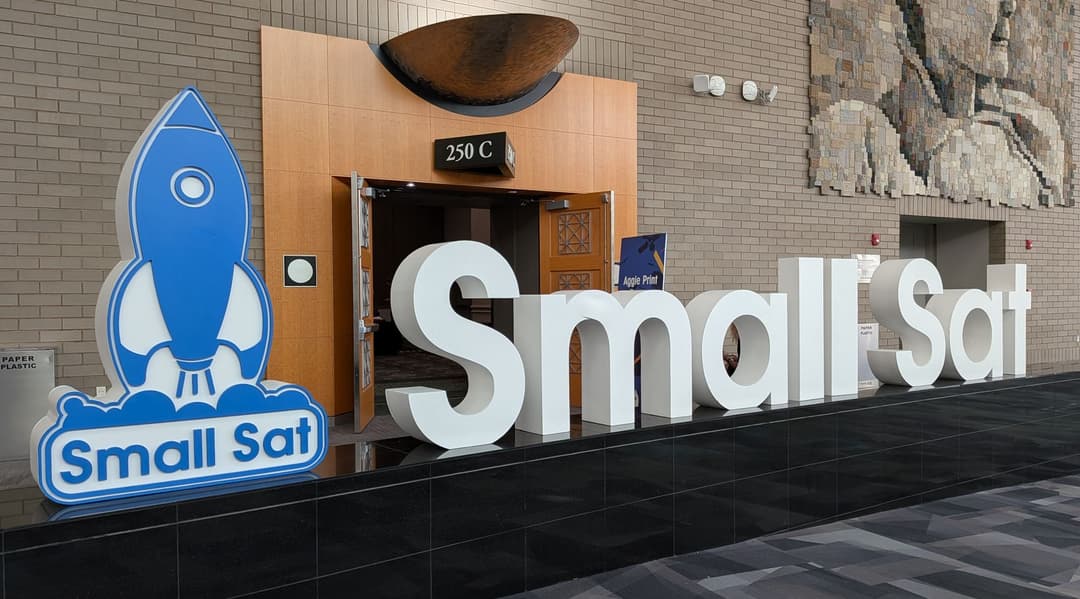
About SmallSat
The 40th Annual Small Satellite Conference ran from 23 to 26 August 2026 at the Salt Palace Convention Center in Salt Lake City, Utah. Organized by Utah State University and the AIAA under the theme "The Clouds Above the Clouds: 40 Years of Collaboration," the 2026 edition marked the event's venue change from USU's Logan campus, where SmallSat had run for most of its four-decade history, to Salt Lake City, reflecting sustained growth in attendance. Approximately 4,000 participants gathered across the four days.
SmallSat leans technical rather than commercial - the program is weighted toward university research groups, NASA field centers, and national laboratories, with roughly 177 papers and talks across four days. The center of gravity in 2026 sat in a familiar set of clusters: autonomous operations and on-board edge AI, radiation-tolerant on-board compute, constellations and swarms, ADCS and pointing, on-orbit anomaly response and mission adaptation, optical inter-satellite links, propulsion, and hyperspectral and SAR payloads.
Defining the native deterministic category
The message Niva led with at SmallSat has sharpened since SATShow in March of this year. Manifold remains a runtime coupled physics engine that is small, fast, edge-deployable, hyper-accurate, and runs continuously against a live world-state fused from real-time sensor data. It operates in the cloud, on edge hardware, in air-gapped facilities, and onboard spacecraft at 10 to 40 watts. What has sharpened is the architectural line Niva now draws around a specific term: end-to-end deterministic, in a category-level sense.
That category exists, and it is distinct from the categories the broader AI and simulation markets have been organized around. It is a class of architecture in which the operational computation itself is a deterministic computation on governing physics, at runtime, against inputs that carry physical meaning. Learned components, where they are present at all, are architecturally bounded to roles that cannot impair the operational path. Determinism, explainability, guaranteed validity, and auditability are properties of the system by construction, not properties achieved by verification layers wrapped around a probabilistic core. Identical inputs produce identical outputs. Every output traces to the inputs and the specific computation that produced it. Outputs are bounded to what the physics admits by the structure of the computation itself. A complete audit trail exists because the computation itself is inspectable and reproducible.
Manifold is one of a small number of productized instances of this category. Others exist (Vinci and Kona are two we are aware of), operating with different mechanisms and in different application domains, but sharing the class-level architectural commitments. The academic literature has not yet organized a clean taxonomy around this class, and the vendor market has not caught up to it. Naming the category, rather than describing Manifold in isolation, is part of the work of the moment.
Why the distinction matters
A recurring pattern across booth conversations at SmallSat 2026 was the loose use of ‘deterministic’, ‘physics-informed’, ‘digital twin’, and ‘runtime’ as vendor positioning language. Two patterns came up most often. In the first, deterministic components (e.g., physics-informed neural networks, propose-and-verify gates, physics-shaped loss terms) sit inside a system whose core is a learned model, and the deployment inherits the probabilistic properties of the learned generator regardless of the deterministic elements around it. In the second, design-time engineering simulation is exported to a device or vehicle for onboard execution and described as runtime, even though a single-shot solve against analyst-configured inputs is architecturally distinct from a continuously coupled runtime computation against a live evolving state.
Neither pattern is a defect in the tools involved. The distinction that matters at deployment is what does the operational work, when it happens, and against what inputs. Manifold delivers a runtime computation of coupled physics against a live world-state, resolved continuously across domains, with class-level determinism, explainability, guaranteed validity, and auditability by construction rather than by verification.
Commercial engagement
The pattern that landed most often on the commercial side played out the same way across booths. A senior engineer or technical leader with a physics, materials, or industry background heard the architectural claim, looked at what was on paper, and stopped.
Not confusion; the moment where the implications catch up. The full model on a Jetson Orin Nano, on a couple hundred dollars of edge compute. Machine-level accuracy, in the sense they knew that term to mean. 60 Hz or higher. Coupled physics computed in real time with verification. A complete world-state built from materials, process, and sensor inputs every 20 milliseconds. Individual physics calculations completing in microseconds. Wait a minute, are you saying this is deterministic end-to-end, coupled physics at runtime, on that hardware, at those speeds? Yes.
From there, the follow-up questions come from a different point of view. How is the physics actually computed? How do the domains couple against a shared state? How does it able to complete multi-physics solutions in less than 20 milliseconds? How does the whole model fit on edge hardware? Probing questions that seek to understand how Manifold can be possible.
At ABB, Safran, Northrop Grumman, and Toray, the application surfaces followed from each listener's own domain fluency. The framing Niva brought gave those conversations a natural anchor: bring us your toughest challenge, the solution that should have worked but didn't, the unsolvable problem. Manifold models the physics with the customer's own data and shows what is actually happening. Space instrumentation calibration and validation. Propulsion and composites manufacturing at scale, where physics-certain characterization at the point of production replaces expert intervention after the fact. Specialized physics-and-process capability (pyrolysis was one instance named) where the expert bottleneck is acute. Constitutive material modeling for virtual experimentation on new formulations. Each engagement surfaced a different domain and the same substrate: production environments where offline simulation was not configured to see the coupled physics that mattered, and where the pace of operations does not allow expert intervention on every batch, cycle, or campaign.
Government engagement
At NASA Ames Research Center's Disruptive Technology booth, the offer to show the team a genuinely disruptive technology was met with immediate interest, and two substantive conversations followed. Manifold's coupled physics has natural insertion surfaces across NASA's smallsat and cubesat programs, and the use cases surfaced from the listeners' own domain fluency. Mars Ingenuity and autonomous surface vehicles. Translunar payloads and orbit mechanics. Deep-space data collection and generalization across regimes with sparse or absent training data. Niva's existing JPL advisor relationships open a coordinated academic-plus-advisor path into program-level conversations from there.
The European Commission's CASSINI Space Entrepreneurship program, run out of EUSPA, exists to strengthen Europe's space innovation ecosystem, backed by the European Commission and the €2 billion CASSINI Investment Facility through InvestEU. Its role is to connect talent, startups, investors, corporates, and the public sector across the European space sector. A runtime physics-native architecture is exactly the kind of differentiated technology CASSINI's program stack is built to circulate through matchmaking, challenge programs, investor networks, and public-sector introductions. Niva sits in that ecosystem as a technology anchor European primes, SMEs, and public-sector customers would benefit from encountering.
Industry-academia bridge
Amongst the many university participants, two engagements at SmallSat 2026 warrant naming. Flight-heritage academic programs with active government contracts and productized spin-out lineages are frequently the source of industry deployment rather than adjacent to it. At Northeastern University, the NU Satellite Lab is building TeraLink, a 6U CubeSat mission for sub-THz orbital communications sponsored by AFRL, NASA JPL, and the University Nanosat Program, whose success criteria (i.e., SNR-margin thresholds, elevation-angle-dependent data rate targets, precision pointing budgets, atmospheric characterization) are exactly the coupled physics Manifold produces. At Aalto University in Espoo, Finland, the Aalto Small Satellites Group pioneered nanosatellite development in Finland and is the origin lab of ICEYE (SAR) and Kuva Space (hyperspectral), both now established Finnish commercial small-satellite operators. Manifold's coupled physics has a natural insertion point at the modeling and characterization layer where these programs operate, and the pathway from an academic engagement to a commercial one is often shorter than the pathway from a cold commercial engagement to a deployed integration.
What this is really about
What happens when you ask a straightforward question of many production systems today? Can I actually understand what is going on behind-the-scenes? If I can, am I able to make decisions from that understanding that are simultaneously actionable, precise, and certain?
For a transformer model producing an output, no. What produced the output is a forward pass through learned parameters whose individual contributions are not separately interpretable, and attribution methods reconstruct a plausible story after the fact rather than explaining what the model did. For a SCADA system monitoring a production line, no. The customer knows the setpoints and the alarms, but not what the coupled physics inside the autoclave is actually doing at any given moment: where the exotherm is peaking, how the resin is flowing, where voids are forming, what the cure state is at each point in the part. Batches ship on setpoint compliance, and the characterization arrives days later from the lab, when the batch is already committed. For an autonomous vehicle operating across genuinely novel conditions, no. The model produces scores that describe how closely the current input resembles the training set, not whether the vehicle should trust its next action, and novel materials, weather, obstacles, and road surfaces sit outside that reference set. The vehicle acts, and whether the action is right is a question the architecture is not built to answer.
The gap is understanding, and the ability to make decisions from that understanding that are actionable, precise, and physics certain. This is what makes Manifold so unique - Manifold understands.
A live world-state constructed from materials, process parameters, and sensor data, computed against governing physics, updated every 20 milliseconds. When Manifold produces an output, the customer knows what the world-state is that produced it, because the world-state is inspectable, the computation is deterministic end-to-end, and every result traces to physics. Decisions grounded in that state are actionable, precise, and physics certain.
For senior engineers, technical leaders, and principal investigators who have been building around that gap for years, the pathway from a booth conversation to a deployed integration is measured in months rather than years, because the problem is already at the top of the customer's unsolved list.
Putting physics-certain understanding, and the decisions it enables, where they belong: at the point of operation, in the systems the world depends on.
What's next for Niva?
Niva's next events follow in short succession. CAMX 2026, the Composites and Advanced Materials Expo, in Atlanta (21-24 September 2026), and The AI Conference 2026 in San Francisco (29 September to 01 October 2026).
On the space and orbital side, commercial engagements from SmallSat and previous conferences continue to move apace across primes, manufacturers, and government space programs. We know there is a better way to do physics-native AI. Niva is proud to share what we’ve built, and demonstrate to others what is now possible, thanks to Manifold.