March 27, 2026 · News
SATShow 2026: physics-native AI meets the satellite industry
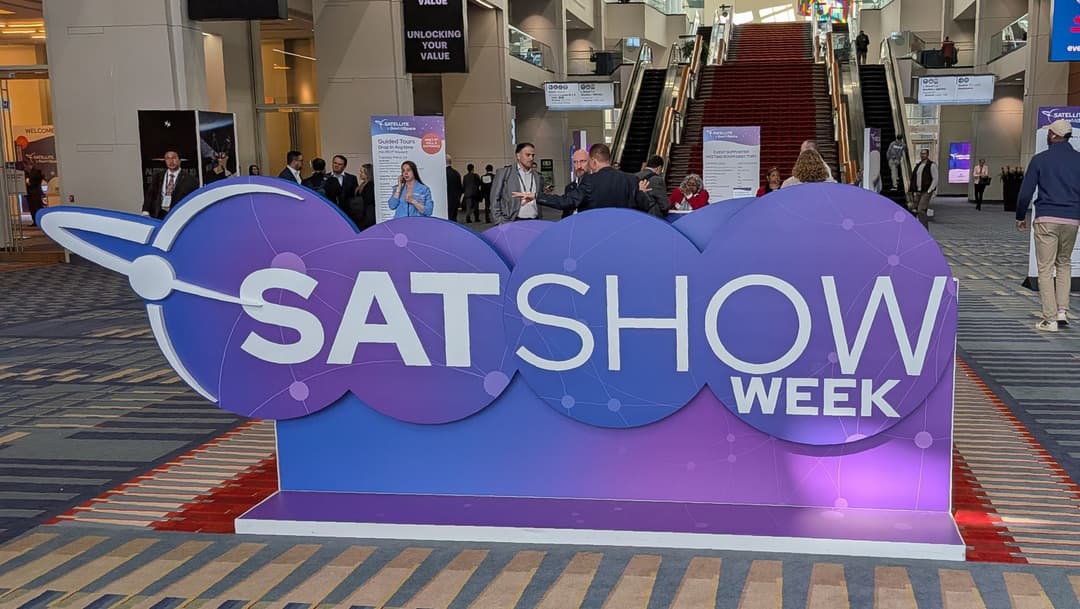
Niva attended SATShow 2026 in Washington, DC (23-26 March), with the goal of introducing Manifold to companies whose domains the platform serves. The value of the show was in the conversations themselves: the questions that came up, the feedback on the positioning, and the interest the platform generated across satellite operators, manufacturers, ground segment providers, primes, and component suppliers.
About SATShow
SATShow Week 2026 (formally SATELLITE and GovMilSpace 2026) ran from March 23 to 26 at the Walter E. Washington Convention Center in DC. The event drew 14,738 attendees from over 100 countries, more than 6,400 companies, and 515 exhibitors across 94,000+ square feet of exhibit space, with roughly 900 prearranged meetings on the calendar. SATELLITE has run since 1981 and is widely considered the largest satellite communications event in the world; GovMilSpace runs alongside as the satellite-focused track for government, military, and allied national security stakeholders. The combined floor covers commercial operators, ground segment providers, manufacturers, launchers, primes, RF and microwave component suppliers, and the full government and defense ecosystem that buys from them.
Niva’s pitch
The positioning Niva led with at SATShow was simple: Manifold, our deterministic, physics-native world model is not transformer-based, like the AI you’ve encountered and used before. Manifold operates from constitutive physics at runtime, fuses real-time sensor data, and does not require datacenter-scale compute or large training datasets. It runs in the cloud, on edge hardware, in air-gapped facilities, or onboard spacecraft at 10 to 40 watts. The differentiation from transformer-based AI on one side and offline simulation tools on the other came through clearly.
The most common response was a specific question: "can you do X?" or "can you do Y?", typically followed by a problem the company had been trying to solve with offline simulation, classical automation, or a transformer model that wasn't working or even considered possible.
Space operator engagement
Niva had engaging conversations with Huber+Suhner, Northrop Grumman, Antaris Space, GMV, Boeing, TICRA, Canon U.S.A., Ramon.Space, Intelsat, Swedish Microwave, Lockheed Martin Space, Terran Orbital, SES, Epic Aerospace, and Deposition Sciences. The level of interest, expressed through a desire to solve specific use cases was both confirming and energizing.
What resonated
A pattern emerged across conversations: the prediction and operations gap. Several companies described domains where they have very limited post-deployment data and rely on pre-deployment prediction and simulation as their primary tool. Electric propulsion providers don't always get telemetry back from deployed thrusters. Satellite manufacturers can't predict ADCS behavior during bus shutdown and recovery windows. Ground segment operators track to centimeter scale on the objects they track, but longer-horizon prediction is an open gap. The recurring shape of the conversation was that operational data is often unavailable, and the tooling that exists to bridge that gap is offline simulation that takes hours to days per run.
That is the gap Manifold is built for. Constitutive physics runs continuously, with deterministic solvers producing every state transition. When real-time sensor data is available, it refines the parameters those physics operate on, sharpening the world model without compromising determinism. The differentiation against offline simulation and against transformer-based AI both showed up clearly across the same set of conversations.
What’s next?
Niva will be attending Web Summit Vancouver in May 2026. Since SATShow, our platform has continued to evolve: lower latency and sharper accuracy verification against published references, additional features, and expansion to new physics domains. The underlying positioning is the same, and something the world has never seen: deterministic AI that operates at runtime, sensor-fused, on edge hardware, without training data, while retaining exceptional accuracy.