April 6, 2026 · News
Demo: Satellite ADCS, bus shutdown prediction with coupled physics warm start recovery
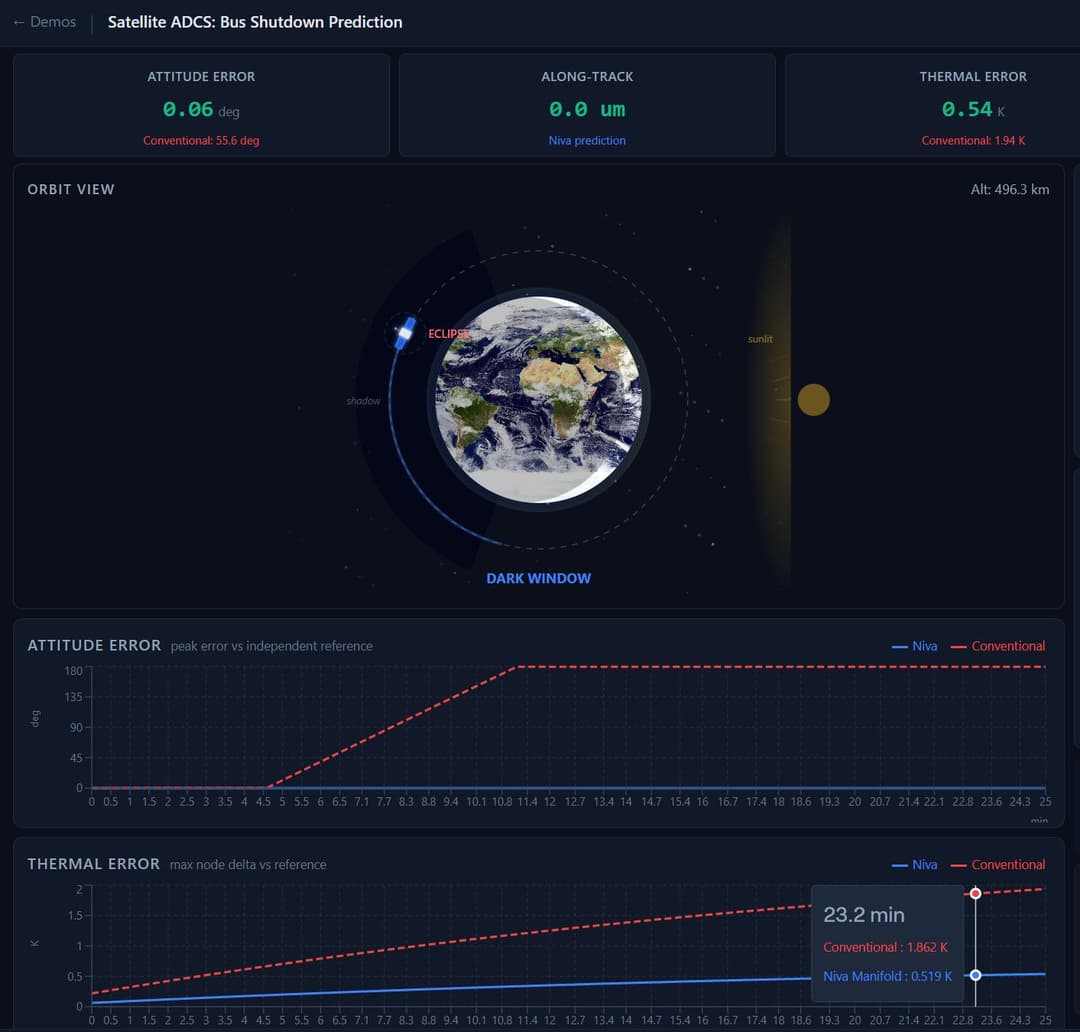
Niva’s Satellite ADCS Shutdown and Recovery is live on the Demos page. The demo, a web-based example of Manifold’s capabilities, runs a three-phase narrative: calibration, where live sensors feed Manifold's physics parameters; dark window, where coupled orbital, attitude, and thermal physics propagate deterministically through the shutdown; and recovery, where the predicted state is handed to the ADCS as a warm start. A side-by-side comparison shows warm-start recovery against conventional cold-start recovery on the same shutdown event.
What the demo does
- Three-phase visualization with timeline scrubber: calibration, dark window propagation, recovery.
- Selectable scenarios spanning different orbits, shutdown durations, and tumble rates.
- Live calibration view: drag coefficient, atmospheric density scale, and magnetic dipole components calibrated from sensor telemetry against published spec values.
- Telemetry panel surfacing star tracker, IMU, GPS, magnetometer, thermistor, and reaction wheel state.
- Recovery comparison: Manifold warm-start vs conventional cold-start, with attitude error and along-track error tracked against an independent reference.
Why this is significant to space operators
Conventional ADCS recovery after a bus shutdown requires rate damping, star tracker search, GPS acquisition, and filter convergence, a sequence that typically takes 5 to 12 minutes. During that window, the spacecraft cannot point at Earth, its communications target, or its science observation. For an Earth observation constellation passing over a target, that recovery window is mission availability lost.
Manifold's coupled physics engine propagates the spacecraft's attitude, orbit, and thermal state through the entire shutdown window deterministically, on the spacecraft, without ground-in-the-loop. When the bus comes back up, the ADCS receives a predicted state with bounded uncertainty rather than starting from scratch. Recovery drops to under 2 minutes. Multiplied across a constellation and across shutdown events per year, the recovered availability is significant.
This is a direct instance of the architecture described in our orbital coupling-chain paper: runtime coupled physics, deterministic commits, edge deployment. The demo is what that architecture looks like running.
Try it out
The demo runs in the browser at https://www.nivatech.io/demos/satellite-adcs.
Other demos are at https://www.nivatech.io/demos.
One platform, multiple domains
Satellite ADCS is one slice of what Manifold does. The same architecture runs satellite thermal analysis at 43 ms, polymer certification at 143 ms, and contact-rich robotic manipulation at 60 Hz. Different domains, same platform: constitutive physics that runs continuously, deterministic solvers producing every state transition, with sensor data refining the world model.