September 22, 2026 · News
Demo: Runtime Cure Control, cure-cycle margin recovery with instance-informed runtime physics
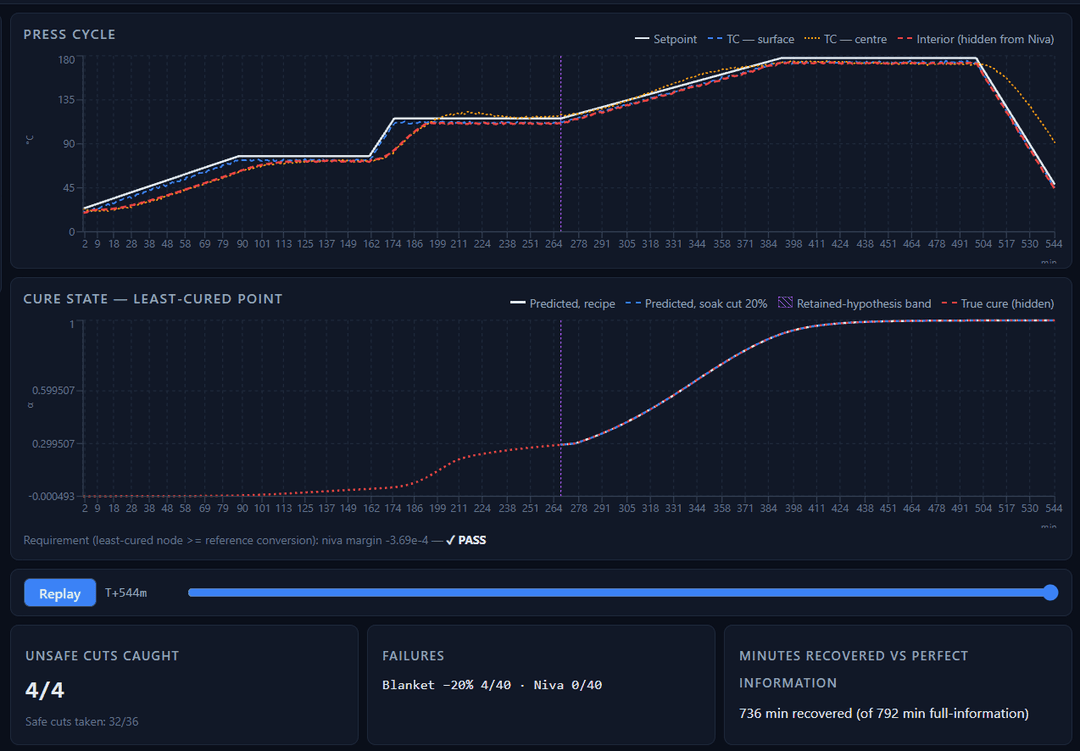
Niva’s Runtime Cure Control is live on the Demos page, released in concert with CAMX 2026 - the Composites and Advanced Materials Expo in Atlanta. The demo, a web-based example of Manifold’s capabilities, which replays 40 blinded carbon/epoxy press loads, is based on research from Niva’s cure-cycle study, published on 21 September 2026.
Manifold is Niva’s physics-native, end-to-end deterministic world model - operating at 60 Hz, edge deployable, verified to the limits of measurement (< 10⁻¹⁵ error for specific solvers) — at speeds that exceed sensor data and physical actions.
The web demo allows an operator to modify load selector, four presets, and cycle playback. Every load runs the same qualified recipe. Calculated throughout, Manifold evaluates the physical hypotheses consistent with that load’s surface and center thermocouple histories, and safely forecasts the least-cured point under a 20% shorter final soak for each one, whereby each cut is allowed if every retained if every prediction element produces a compliant outcome.
The demo shows each decision alongside the study’s six quality checks under the cut.
What the demo does
- Press-cycle view with the setpoint, the surface and center thermocouple traces, and the laminate interior temperature, which Manifold never sees.
- Cure-state view of the least-cured point: predicted cure under the recipe and under the cut, the band of retained physical hypotheses, and the hidden true cure.
- Quality checks under the cut for the incumbent recipe, a blanket 20% cut, and Manifold’s decision: cure completion, gel timing, final-soak overshoot, reference-anchored peak, the 199 °C cap, and recipe admissibility.
- A strip of all 40 loads marking each take or decline and whether the cut was safe.
- Four presets: a load where Niva takes the cut, one where it declines, one where the blanket cut fails, and one of the four safe cuts Niva declined.
- Running totals for unsafe cuts declined, new failures, and minutes recovered against the full-information benchmark.
Why this matters to manufacturers and the composites industry
A cure recipe is qualified for the most demanding load in its envelope, then run open-loop on every load. Offline cure simulation improves the recipe, but it cannot tell which conditions are present in a given run, so every less-demanding load carries the same hold. Cutting the final soak by 20% on all 40 loads would recover 847 minutes and introduce four new failures; a 10% cut still introduces three. Manifold took the cut on 32 loads and declined 8, including all 4 unsafe ones. It recovered 736 minutes, which is 92.9% of the 792 minutes a selector with perfect knowledge of every load could recover without a new failure. Each accepted cut removed 13.4 minutes of hold and released 14 to 28 minutes of cycle, because cooldown and release respond to the shorter soak. Averaged across all 40 loads, that is 18.4 minutes per load, or 3.5% of cycle time.
For a cure-bound line, released press, mold, or autoclave time is capacity from assets already installed. An IACMI project with TPI Composites and Purdue University found that waiting for resin to cure was the largest bottleneck in wind-blade spar-cap throughput, and that cure was deliberately slowed to prevent fiber buckling (Sharp et al. 2020).
Manifold deterministically performs real-time coupled physics, in a training-free approach that remains hyper-accurate across regime, materials, and scenarios: each take or decline traces to named physical hypotheses, a forecast, and a pass-or-fail check. Within the tested sensor map, it adds no sensor, vessel, or actuator, and the qualified recipe stays in force on every load where it declines the cut. In the study, each decision took about 11 seconds against an 8.7-hour mean cycle.
The demo replays the confirmation set from Niva’s technical report, The Recipe Is Not the Part: Recovering Composite Cure-Cycle Margin with Instance-Informed Runtime Physics. The study is a simulation of one material (AS4/3501-6) and one thick-laminate press-cure family, with one intervention. Its failures are scored against the study’s six qualification checks, relative to the reference cure cycle and physical validation.
Try it out
The demo runs in the browser at https://www.nivatech.io/demos/cure-control.
Other demos are available at https://www.nivatech.io/demos.
The full Composite Cure technical report:
One platform, multiple domains
Runtime Cure Control is a single application focus of what Manifold can perform. The same architecture runs satellite thermal analysis at 43 ms, polymer certification at 143 ms, and warm-start ADCS recovery after a bus shutdown in under 2 minutes. Different domains, same platform: constitutive physics that runs continuously, deterministic solvers producing every state transition, with sensor data refining the world model.